Welcome back to our cogbites interview series, where we interview cognitive scientists by asking them a few questions about their interests in science and what keeps them engaged both in and out of the lab.
As a reminder, you can learn a little about our own team of contributors by reading their bios (either on our author page or at the bottom of each post), but this is a chance to get to know some early-career scientists even better. Our last interview was with Nicolas Scrutton Alvarado, a Ph.D. student in the Department of Neurobiology at Northwestern University.
This week we interview Analia Marzoratti, a 3rd year Ph.D. student in the School of Education and Human Development at the University of Virginia. Analia is pursuing a Ph.D. in Educational Psychology (Applied Developmental Science) with Dr. Tanya Evans as her advisor.
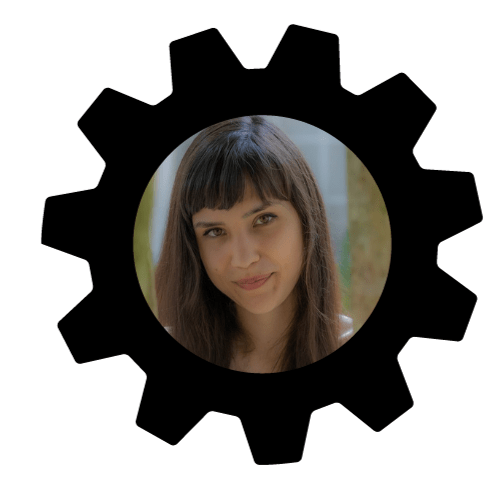
Analia’s research is focused on identifying how specific differences in children’s early environments (such as those linked to poverty) affect patterns in their brain activity, cognitive strategies, and learning processes. She examines factors including children’s home learning environments, access to supportive others, and subjective experiences of their context. She aims to make findings in developmental cognitive neuroscience accessible to practitioners, policymakers, and community members. That way, Analia can use science to shape a more equitable education system based on an understanding of neurobiology, the nature of learning, and the unique needs of the children it serves.
Analia recently wrote a blog post on cogbites about how a musical task can help identify children who are at risk for reading difficulties. Be sure to check it out!
In the meantime, here’s our interview with Analia:
Why did you decide to pursue cognitive science?
I grew up in South Carolina as a member of their public school system. In high school, I was part of an advocacy campaign geared towards policymakers which was fighting for reform in the under-funded, historically under-performing school districts along highway I-95 in my state. Talking with students through this project, I realized that unique environmental circumstances at home and school may change what kind of instruction they need, either based on their exposure to learning material or differences in how the brain operates. Using current best practices in teacher training may help some students learn more than it helps others. I had always been interested in understanding or predicting how people think and was thinking of pursuing psychology. However, this experience convinced me that understanding the specific aspects of the physical brain and the way that the brain processes information that is linked to some of these learning differences could help us make informed changes in how we teach to specifically accommodate students’ needs.
What are you currently working on?
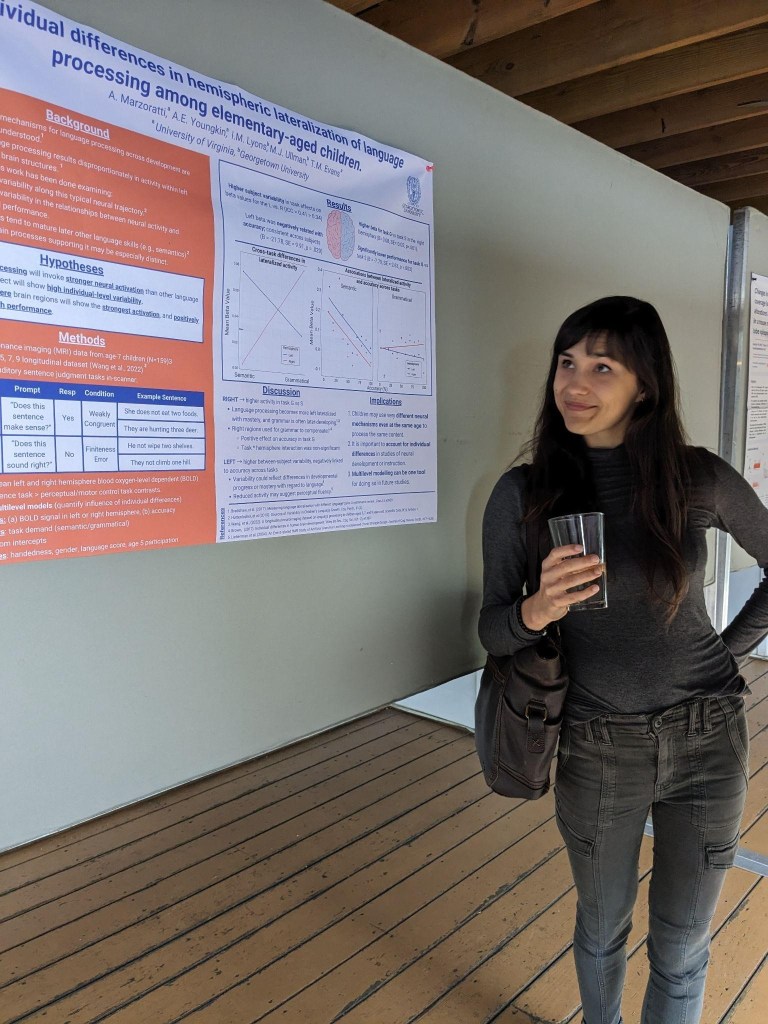
Right now, my main research project involves evaluating differences in how much children use brain networks for two different forms of long-term memory while solving single-digit math problems, and how this affects their performance. This research is important because there are direct ties between which of these brain networks a child uses and what teaching strategies will be most effective for their ongoing math learning. Declarative memory is associated with conscious retrieval (like directly thinking ‘2 + 2 = 4’), while procedural memory involves unconscious retrieval, often of sensory or motor memories (like finger-counting). Our sample includes children ages 7 and 9, either just starting math in school, or a few years into it. We measure their brain activity using magnetic resonance imaging (MRI), meaning we have them do math in a giant magnetic tube! I am also evaluating whether socioeconomic status (SES) or factors such as average hours of sleep or activity, home chaos, or home crowding might affect these brain-level links between long-term memory and math.
What’s the most exciting development in cognitive science?
I’m really excited about all the new neuroimaging technology allowing for increasingly high-quality brain recordings outside of the lab! This technology will allow us to study kids’ brains in the actual environments where they engage in the processes that we want to study, like learning or interacting with others. We can learn more about children’s development in the ways it actually happens versus what it looks like in a controlled lab setting. This is leading researchers to focus more on identifying factors that predict individual differences in brain function (like home environment, teacher quality, etc.), which is important to me as someone who cares about brain-based individualized instruction. This new technology is also opening up the populations we can study beyond just those kids who happen to live close to a university.
What sparked your interest in science communication?
I knew from high school that I wanted to promote change in schools using science, meaning I would need to translate my findings in ways that were useful to teachers, parents, and students with varying levels of science literacy. As an undergraduate, my work had me recruiting bilingual families from high- and low-income communities, and I also found that the ways that I explained our work made a huge impact on their willingness to participate and trust in research. Because of this, one of my main goals has become to develop my skills in communicating science. This way I can help bridge gaps in science education and make important findings more equally accessible to the non-academic populations that I hope to help.

Is there anything else you want us to know about you?
I’m a big writer, reader, and consumer of all things fiction, especially anything in the science fiction, horror, or thriller genres. I read books, watch movies and TV, listen to podcasts, and write as much as possible with my schedule. I even met my partner in a creative writing class! I like rock climbing and hiking or doing anything outside too, and I have a hairless cat named Harvey Dent.
 cogbites
[…] a chance to get to know some early-career scientists even better. Our last interview was with Analia Marzoratti, a Ph.D. student in the School of Education and Human Development at the University of […]
LikeLike