
New research sheds light onto the age-old question of why insects seem so inexplicably drawn to artificial lights – and it’s not what you expect.

Reference: Fabian, S. T., Sondhi, Y., Allen, P. E., Theobald, J. C., & Lin, H.-T. (2024). Why flying insects gather at artificial light. Nature Communications, 15(1).
While sitting outside on a warm summer’s night, enjoying the smell of newly bloomed flowers and freshly cut grass, we are often accompanied by an unwanted soundtrack: the endless buzzing of dozens of bugs, flying around our lights. This behavior is not only annoying but also apparently self-destructive – the insects frequently fly too close to the light bulbs and are zapped to death. So why are insects so mesmerized by artificial lights?
Scientists have known for thousands of years that insects get stuck on artificial lights at night. Traps used by researchers to collect nocturnal insects (insects that are most active at night) are even designed using bright light sources as lures. The causes for this behavior, however, have remained mysterious. Some of the main theories include insects being blinded by the brightness of the lights or being attracted to the light’s warmth.
This question has remained unanswered for so long because testing any of these theories has not been easy. Understanding what makes insects attracted to lights in the dark requires taking videos of these tiny animals in settings that are really, well, dark. If you have ever tried taking a video in a badly-lit room, you can understand how challenging this kind of experiment can be. By developing a new way of tracking insects in the dark, a group from the Florida International University might have finally found the answers to this decades-old question. A study published in the scientific journal Nature Communications earlier this year suggests that night flying insects use the brightest part of the world – the night sky – to tell which way is up. Nighttime environments with bright artificial lights everywhere confuse the insects’ sense of up and down, leading to this apparently self-destructive behavior of spiraling into light sources.
“The really exciting element of the work is finally beginning to understand a behavior that humans have likely observed since they first made fires,” says Dr. Fabian, the leading author of this study. By using modern infrared high speed cameras and motion capture technology, we can finally start to answer this very old question.
Setting up an insect photoshoot
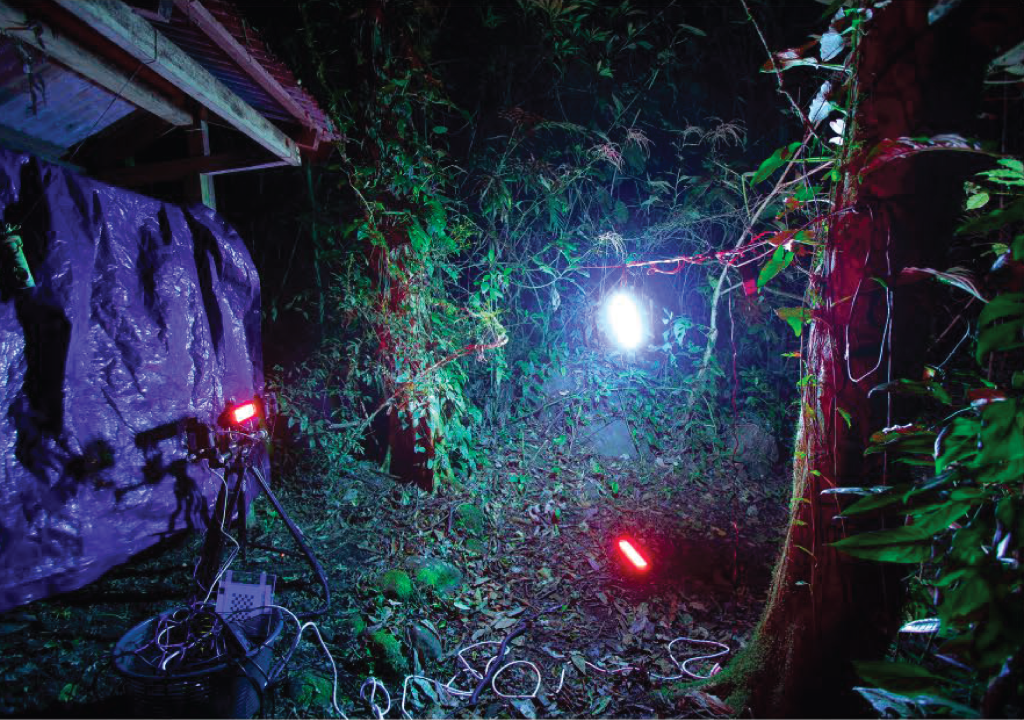
To understand why insects are attracted to artificial lights, scientists started by filming nocturnal insects flying around a light bulb in the wild.
For this, researchers set up a makeshift studio in a field station in Costa Rica. There, they took almost 500 videos of more than 10 different groups of flying insects of all types, from beetles and flies to moths and even cockroaches. These videos were full of examples of insects endlessly spinning around the light bulb – and sometimes falling into the light.
There were, however, also two surprising things that the insects seemed to do when close to the light source. The first one, which the scientists named stalling, consisted of flying straight upwards until they slowed down and couldn’t fly anymore – like an acrobatic plane that slows down midway through a loop. The second, which the researchers called inverting, looked like the animals were trying to fly belly-up, causing them to crash into the ground. None of these behaviors could be explained by any of the existing theories about why insects were attracted to artificial lights, which suggested there was something unexpected happening to these animals. To better understand these surprising behaviors, the scientists went back to the lab.
In the lab, researchers created an arena using motion-capture techniques used in film and video-games, just miniaturized for small insects. This setup had a single white light bulb in the center that insects flew around. The researchers put T-shaped plastic frames on the insect’s backs that reflected infrared light (a wavelength of light that cameras can see, but insects and humans can’t). This allowed them to know exactly which way insects’ bodies were pointing at all times, just like those like white dots humans wear over green suits for motion-capture.
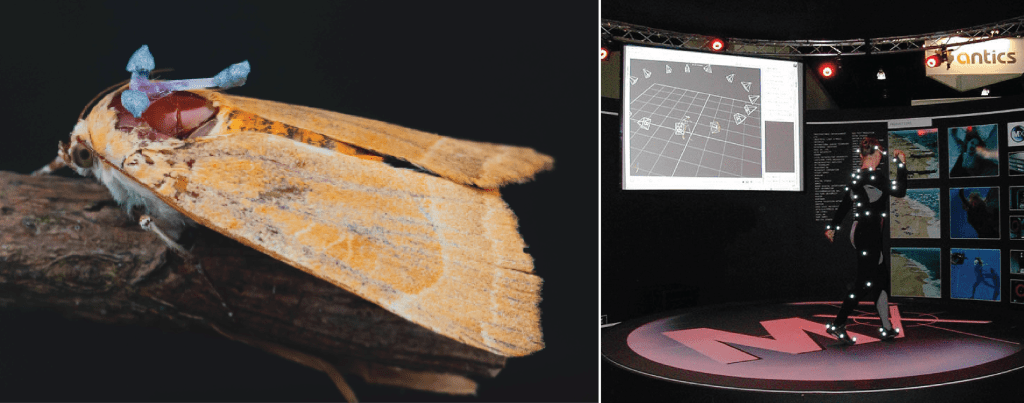
After watching hundreds of frames of insect flight footage, scientists found that the insects were turning during flight so as to always keep the light bulb over their backs. This flight pattern didn’t fit with any of the previously proposed models for light orbiting, so what could explain this puzzling behavior?
Nocturnal flying insects use vision to tell which way is up
When we imagine what flying might feel like, most of us probably picture peacefully soaring through the skies. While this picture might be true for large animals such as eagles, insects have a very different flight experience. Because these animals are very small and lightweight, they are easily taken of course by air currents and jostled around by gusts of wind. For insects, flying is much more similar to how it feels when we swim in a rough sea, constantly being tossed around by waves and struggling to not be swept away by ocean currents.
In such a hectic environment, it can be very difficult for insects to know where they are going or even which way is up. So how can a little flying insect tell if it’s flying right-side up?
Scientists think that insects might be solving this problem by using vision and making one very simple assumption: the sky is light and the ground is dark. So, by keeping the brightest part of the world above their backs, during day or night, they can be sure to be flying right side up. Or at least they could, before humans came along.
What shines brighter than the moon at night? Our light bulbs.
If you have ever tried to watch the stars at night in your backyard, you have probably noticed that the night sky is no longer the brightest thing around at night. With the spread of artificial lighting throughout the 20th century, bright light sources are everywhere at night – a big problem for nocturnal insects.
Using the brightest part of the world to tell which way is up works very well if the light source is actually above you, like the sky, but not so much if it’s next to you or beneath you, like a light bulb. If the light you are using to work out which way is up comes from beneath you, you will flip your body upside down, causing you to crash on the ground. When light comes from the side, you would constantly roll your body, like a plane constantly performing a turning maneuver, leading to unintentional circling of the light source. These strange and seemingly counter-productive movement patterns are exactly what researchers saw insects doing around light sources in their experiments.
One important point, Dr. Fabian says, is that “…it’s important to understand this [phenomenon] doesn’t happen because insects are stupid. Insects are phenomenally well tuned to match their environment, and developed this wonderful simple rule that light comes from above, which they then relied on. This has been true for millions of years, and only just now have we broken that rule. Flying insect behavior is beautifully tuned to a world that generally no longer exists.”
Understanding how artificial lights affect nocturnal insects doesn’t just solve a decade-long puzzle for scientists, but might also be important for insect conservation efforts. Insect populations are declining worldwide at alarming rates, with a recent study estimating that we are losing about 9% of the land-dwelling insect population every decade. This unprecedented loss is due to several different factors, like habitat loss, pesticides and climate change, but artificial lighting might be also playing an under-appreciated role. Understanding the mechanism that drives insect light-attraction can help us design insect-friendly lighting systems that can benefit the environment and keep our front porches bug-free.
Additional Reference
van Klink, R., Bowler, D. E., Gongalsky, K. B., Swengel, A. B., Gentile, A., & Chase, J. M. (2020). Meta-analysis reveals declines in terrestrial but increases in freshwater insect abundances. Science, 368(6489), 417–420. https://doi.org/10.1126/science.aax9931
 cogbites