
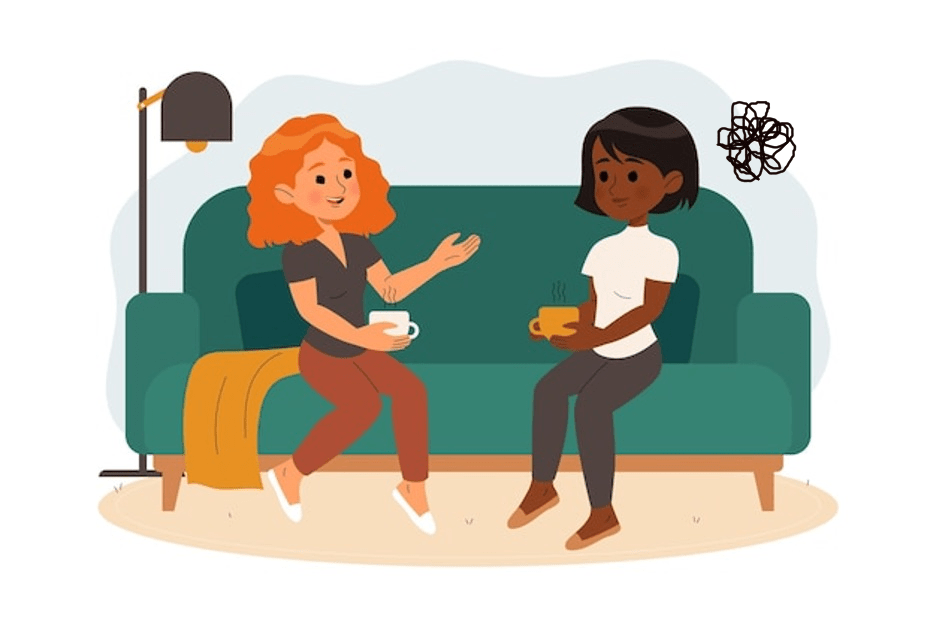
Reference: Collins, H. K., Minson, J. A., Kristal, A., & Brooks, A. W. (2024). Conveying and detecting listening during live conversation. Journal of Experimental Psychology: General, 153(2), 473–494.
When we speak, we want others to listen, and we want to feel heard. But new research suggests that what matters isn’t whether people are actually listening—it’s whether they seem to be. In a series of experiments, researcher Hanne Collins and her colleagues demonstrated that people are remarkably bad at telling the difference between attentive and inattentive listening in their conversation partners. By the same token, people are remarkably good at feigning listening even when their minds are somewhere else entirely.
How We Fail to Detect Attention in Conversations
Face-to-Face Failures
In the first of these experiments, participants paired up with strangers to have face-to-face 5-minute conversations. They were instructed to get to know each other and assess whether they would make good roommates. A large video screen in the room faced one participant in each pair, who was designated the “target” (i.e., the target of perception). Targets were split into three groups: the first group was instructed to ignore the videos and listen attentively to their partners, the second was told to attend to the videos, and the third was told to attend to the videos while pretending to listen attentively to their partners. After the conversations, their conversation partners, the “perceivers,” rated the listening quality of the targets. Interestingly, perceivers were unable to distinguish between targets who were fully attentive and those who were distracted by the videos on the screen.
But what about outside observers—are they better at spotting inattentiveness? The researchers explored this idea next. The research team recruited additional participants to watch video recordings of the conversations from the prior experiment and rate target listening on the same scale as before. These third-party observers also failed at distinguishing attentive from inattentive listeners. Additionally, there appeared to be no reliable behavioral cues – such as decreased eye contact, less engaged body posture, or altered speech patterns – that signaled an attentive conversation partner.
A Failure to Detect Attentive Listening Cues in Oneself
It turns out we’re surprisingly bad at telling whether someone is truly paying attention to us. Could this be because we assume by default that others are always attentively listening in conversations? To explore this question, the researchers recorded participants as they listened both attentively and inattentively to an experimenter reading two stories aloud, while music played in the room. The same participants then watched a series of 5-second clips of muted playbacks of themselves mere minutes after they were recorded and guessed whether they had been listening attentively. These participants were accurate only 64% of the time, highlighting their difficulty to detect cues of attentive listening, even when aware of the likelihood of inattention.

The final experiment took place over zoom.
The Art of Fake Listening
In the experiments thus far, participants were distracted during conversation, but are people simply good at attending to multiple things at once? In a final experiment, participants had one-on-one, 10-minute video chats with 2-3 partners. Like before, half of participants were designated the “targets,” and the other half the “perceivers.” The audio that the target heard in each conversation was garbled at regular intervals using a voice filter that rendered entire segments of speech unintelligible, ranging from 0% to 75% of all speech. Despite these disruptions, targets were instructed to hold the conversation as if they could hear everything their conversation partners said. Perceivers rated the extent to which their partner was attentively listening to them at 5-minute intervals throughout the conversations. Remarkably, perceivers did not rate the targets’ listening quality or responsiveness differently, regardless of how much audio was garbled. These outcomes demonstrate just how skilled people are at creating the illusion of attentive listening.
Bridging the Gap Between Feeling Heard and Being Heard
Together, these results suggest that there exists a considerable gap between feeling heard and actually being heard. In everyday conversations, people are so well-practiced in nodding, making eye contact, murmuring a “yeah” here and an “mm-hmm” there that it has become nearly impossible to tell when they are attentively listening instead of mind-wandering about what they’re going to eat for dinner. And we all do it—no one can be fully attentive all of the time. When an unrelated thought distracts us during a conversation, we rarely stop our conversation partners to ask them to repeat themselves. Instead, we nod along, praying that the next segment of conversation will give us enough information to convince our partners that we were paying attention all along. Just because we can get away with feigning listening doesn’t mean we should, though. In some cases, the effects of feeling heard are positive enough that it may not matter whether one was truly heard. In other cases, however, it takes a toll on relationships: if the same topic resurfaces in conversation, it can become obvious if one person completely zoned out previously.
Conversations are the building blocks of relationships, filled with shared understanding and inside jokes. But when one person zones out, that connection can fray. A simple, “Sorry, I missed that—can you repeat it?” can go a long way in building stronger connections.
Images:
Cover photo- Modified image designed by Freepik
Zoom conversation sketch- Modified image designed by Freepik


[…] social connection. She recently contributed a blog post to Cogbites about a fascinating topic: how people fake listening in conversations. Keep an eye out for more engaging science writing from her in the […]
LikeLike
[…] followed, and the unspoken message that their ideas did not matter settled into the culture. The illusion of listening had done more damage than silence would […]
LikeLike