
Reference: Chen, C., Wang, J., Li, K. et al. (2015). Visual fatigue caused by watching 3DTV: An fMRI study. BioMedical Engineering Online, 14 (Suppl 1), S12.
Have your eyes ever felt tired after watching a 3D movie? It turns out that this discomfort might also affect your brain’s performance. Next time you are taking an important test, you may want to think twice about watching a 3D movie beforehand. Research suggests that watching a 3D movie may harm your performance on tasks which require processing visual information, such as playing a sport like tennis or driving a car. This is because watching a 3D movie can cause visual fatigue, which has been linked to changes in brain activity and impacts cognitive performance. In a new study, participants watched either a 2D or 3D movie and then performed effortful visual attention tasks. Researchers found that reaction time worsened after watching a 3D movie. What was even more surprising were the brain changes that accompanied this reduction in task performance.
When our Visual System’s Complexity May Hinder Us
Because our environments are three-dimensional, it is easy to take for granted the complexity built into our visual systems for processing 3D stimuli. Part of this complexity arises from the interconnectedness of our visual processing system with other brain areas. For example, visual information is carried along a pathway which leads to the occipital lobe. The occipital lobe, in turn, has connections to other parts of the brain that support various mental functions, such as visual attention, object recognition, and spatial awareness. For example, the dorsal attention pathway helps guide eye movements and spatial attention, while the ventral pathway aids in identifying and interpreting visual objects (see Figure 1 below).
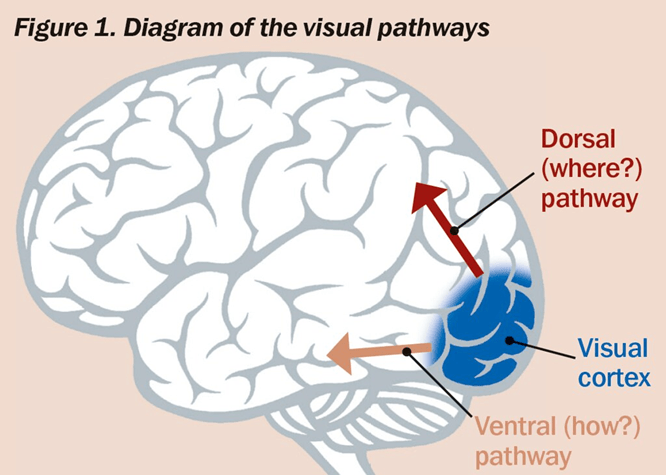
Image from Community Eye Health Journal Vol. 29 No. 93 2016
Considering this, work has begun to investigate the effects of various visual experiences on cognitive processes. Researchers first examined the connection between 3D movies and visual fatigue (commonly referred to as eye strain). 3D visual fatigue can be evaluated using event related potentials (ERPs; 2), a way of measuring how the brain reacts to specific visual events, or using fNIRS, a brain imaging tool that tracks changes in blood flow in response to neural activity (3). Visual fatigue following the viewing of a 3D movie was also shown to impact autonomic regulation, inducing sustained activation of the part of the nervous system that prepares the body for stressful or dangerous situations, and altering heart rhythm (4).
From these discoveries, researchers turned to examining cognitive function in relation to 3D movie-induced visual fatigue. Employing functional magnetic resonance imaging (fMRI), the present study found different patterns of occipital lobe brain activity in a task which required participants to process visual information presented across different depths following the viewing of a 3D movie compared to a 2D movie.
How Researchers Explored the Relationship Between 3D Movies, Visual Fatigue, Brain Activity, and Cognitive Performance
In the current study, researchers set out to explore the association between 3D movie visual fatigue, brain activity, and cognitive performance. They began by evaluating critical flicker fusion frequency (the frequency at which flickering light can be perceived as continuous), a measure which has been used to index visual fatigue for participants (5, 6). Participants then completed visual and auditory Go/No-Go tasks. Go/No-Go tasks are commonly used to assess response inhibition and cognitive control by requiring participants to respond to certain stimuli (Go) while withholding responses to others (No-Go). They are often used in research on executive function, impulse control, and disorders such as ADHD and addiction (7). In the visual version of the task, stimuli were signified by color, while stimuli in the auditory task consisted of different tones. Cognitive performance was determined by accuracy and response time on both Go/NoGo tasks. Following the tasks, participants then watched either a 1-hour 2D movie or a 3D movie. After the movie, critical flicker fusion frequency was once again evaluated, and participants completed the auditory and visual Go/NoGo tasks again. During both rounds of the cognitive tasks, brain activity was measured via fMRI. This experimental design allowed for differences in visual fatigue, cognitive performance, and brain activity to be measured before and after watching a movie and it allowed for the comparison between watching a 2D movie and a 3D movie.
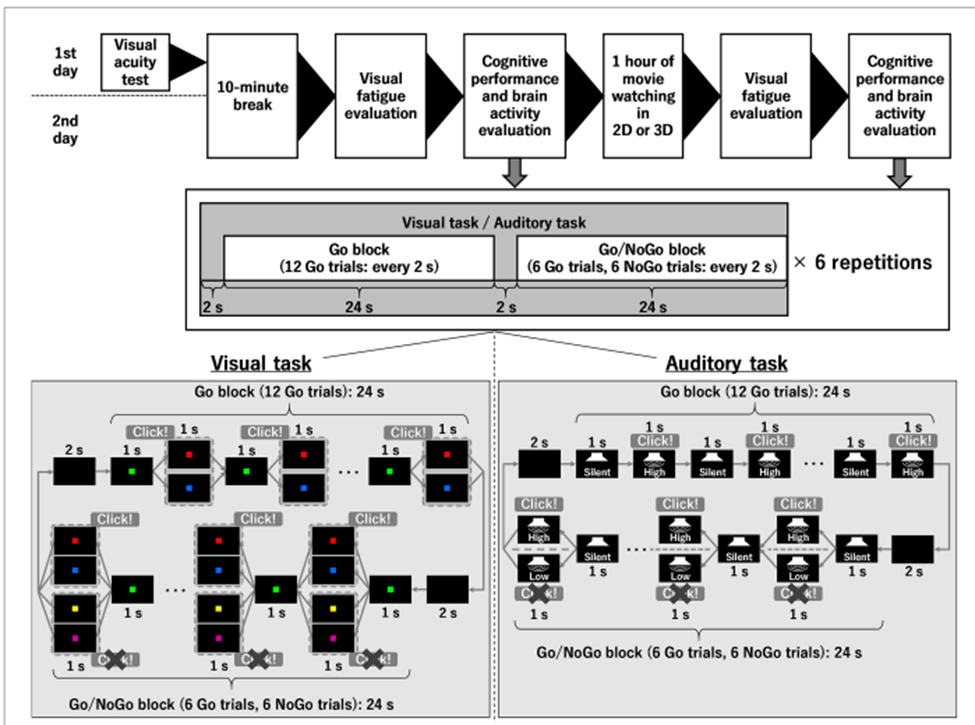
This method yielded several striking results. First, as expected, participants showed greater visual fatigue after watching the 3D movie compared to the 2D movie. Second, the reaction time for the visual Go/No-Go task worsened after watching the 3D movie. Perhaps surprisingly, after watching the 3D movie, people who had seen the 3D movies showed decreased activity in primary somatosensory cortex during the cognitive task. This reduced brain activity likely negatively impacted cognitive performance in the visual task. These findings indicate that watching a 3D movie results in greater visual fatigue than watching a 2D movie, and that brain activity and cognitive performance are also affected.
Why Does This Matter?
These findings provide interesting and important insight into the potential impacts of an activity most of us are familiar with or have personally experienced. They also raise more questions: What other cognitive tasks might also be affected by visual fatigue? Could other common activities lead to visual fatigue? What are some potential solutions to mitigate these effects? It is also important to deliberate from these findings how the development of 3D technology going forward may best consider potential cognitive implications arising from its advancement. On an individual level, next time you’re planning to drive or study, consider skipping the 3D movie to avoid mental fatigue. 3D movies are fun, but they might come with hidden costs—next time, think twice about how they could affect your focus.
 cogbites