Reference: Holochwost, S. J., Coffman, J. L., Wagner, N. J., Gomes, L. A., & Propper, C. B. (2024). Parasympathetic nervous system activity during measures of volitional self-regulation predicts school readiness. Mind, Brain, and Education, 18(3), 333–345.
In a previous chapter of my life—before academia—I was a behavior therapist. I worked with kids on the autism spectrum, and kids who had attention deficit hyperactivity disorder (ADHD), as young as three years old. It was always wonderful, joyful chaos playing with and teaching them at the same time. Amid the laughter and energy, one of the most important skills we focused on was self-regulation. Building this skill made the chaos more manageable—not just for me and their caregivers, but for the kid themselves.
Self-regulation is the ability of our minds to manage one’s emotions, attention, and impulses. It supports us across a wide range of activities and tasks we all encounter every day; for instance, when I need to be working on my dissertation, but I want to play video games or go read a book, I use my self-regulation skills to refocus my attention on my work instead of giving into my impulses (no matter how I might feel about it at the time). Self-regulation also plays a vital role in social interactions and academic success—two areas that preschoolers are just beginning to navigate but will rely on throughout their lives.
So how can we tell how self-regulated a preschooler is? And does that tell us how they’ll do in school, where both social and academic skills are needed? Holochwost et al. (2024) explored this idea. They examined how one of our core regulatory systems might shed light on a child’s readiness for school.
What are Self-Regulation and the Parasympathetic Nervous System?
As mentioned earlier, the mind’s ability to self-regulate enables us to exercise control over how we think, what we pay attention to, manage our impulses, and handle how we feel. Whether someone is learning or socializing—preschoolers included—self-regulation helps them stay focused on what they need to do, even when they’re tempted to focus on something else.
A part of our nervous system called the parasympathetic nervous system, or PNS, supports our mind’s ability to help us self-regulate. The PNS plays a key role in helping us rest and recover from stress—one example of keeping ourselves regulated, especially when we’re doing something tough. An example might be the PNS helping a preschooler stay calm and focused (and self-regulated!) when socializing or learning in school.
One way researchers can measure how the PNS is working is heart rate variability (HRV)—the natural variation in time between heartbeats. Higher HRV indicates that the body is flexible and responsive: even in the face of stress, it can return to a calm, baseline state. This kind of physiological flexibility supports emotional regulation and sustained attention—two crucial ingredients for self-regulation during challenging tasks.
How Researchers Studied Preschoolers’ Readiness for School
Holochwost et al. (2024) set out to explore whether heart rate variability (HRV) measured during self-regulation tasks could predict school readiness in preschoolers. In other words, they wanted to know: Does a child’s physiological regulation relate to how ready they are for school? To investigate this idea, the researchers examined the quantitative relationship between HRV and scores on self-regulation and school readiness measures. They gathered several types of data:
- HRV Assessment: The research team used an electrocardiogram (ECG; a device you might have seen at a doctor’s office) to measure each child’s HRV while they engaged in various self-regulation tasks.
- Self-Regulation Tasks: Preschoolers complete tasks that were designed to test skills like focusing, resisting impulses, and persistently working towards goals —all skills you would need in school. For example, one task involved waiting to open a present while left alone—something that requires serious self-control for a young child!
- School Readiness Assessment: Finally, the researchers evaluated the children’s cognitive, social, and emotional development through a school readiness assessment
Key Findings: Physiological Regulation as a Predictor of School Readiness
The data revealed two key findings. First, preschoolers who showed higher HRV during the self-regulation tasks performed better at skills like focusing attention, resisting impulses, and sticking with goals. These same children also scored higher on the school readiness assessment—suggesting that HRV is a meaningful predictor of how prepared a child is for the classroom.
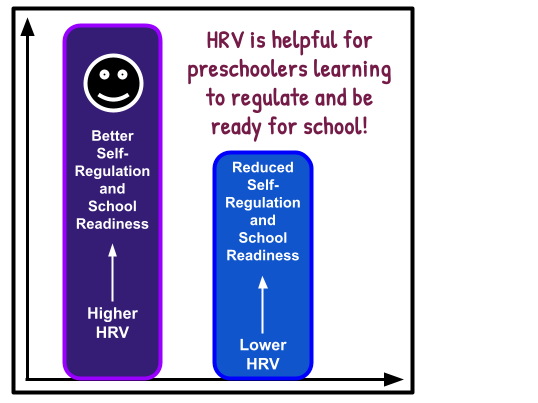
Even more compelling, these patterns held true regardless of the child’s age or socioeconomic background, highlighting that the connection between physiological regulation and school readiness is robust across different groups.
In short, Holochwost et al. concluded that a well-regulated parasympathetic nervous system—as reflected in higher HRV—plays a foundational role in supporting the cognitive and emotional skills that children need as they enter school.
What Does this Mean for You?

The findings from this research highlight how supporting self-regulation through the parasympathetic nervous system (PNS)—and specifically heart rate variability (HRV)—can play a key role in helping young children thrive. For caregivers, this could mean incorporating simple stress-management practices into daily routines, like deep breathing exercises or kid-friendly yoga, to help children calm their bodies and build emotional control. Encouraging children to talk about their feelings and learn strategies for managing emotions can further strengthen self-regulation and school readiness.
Educators can also make a difference by using engaging, playful activities that build attention and impulse control—think of games like Simon Says or Red Light, Green Light, which sneakily build core regulatory skills while keeping kids active and having fun.
Looking ahead, HRV might even become a useful tool to help identify children who could benefit from early intervention, allowing families and educators to provide support before school challenges arise.
Conclusion
This study makes the following very clear: the parasympathetic nervous system makes every heartbeat of ours a building block to success—no matter how old you are. Our heart rate variability isn’t just some biological side note; instead, it is fundamental to self-regulation and school readiness. Holochwost et al. (2024) challenge us to rethink early learning by showing that nurturing our children’s bodies is as crucial as nurturing their minds. Build from the heartbeat up, and the future will follow.
 cogbites