
Reference: Speer, S. P., Mwilambwe-Tshilobo, L., Tsoi, L., Burns, S. M., Falk, E. B., & Tamir, D. I. (2024). Hyperscanning shows friends explore and strangers converge in conversation. Nature Communications, 15(1), 7781.
Whether it’s catching up with an old friend or meeting someone for the first time, people connect with others through conversation. Decades of research would say that being “on the same page” characterizes connection; friends tend to share similar linguistic styles in writing (1) and even show similar brain responses when viewing videos, suggesting that they tend to see the world through a similar lens (2). Alignment makes interactions feel smooth—after all, being able to finish each other’s sentences or knowing exactly what another person means with just a glance are telltale signs of close friendship. But connection isn’t just about sameness. Too much similarity can make conversations boring. People are drawn to novelty and discovery, and dialogue also offers a chance to be challenged on one’s own views and see the world in a different way.
Examining conversations between friends and strangers
Princeton researcher Dr. Sebastian Speer and colleagues conducted a study to investigate how friends and strangers may differ in the way they balance finding common ground and exploring new terrain in conversation. Sixty pairs of participants, including 30 pairs of friends and 30 pairs of strangers, were recruited to have conversations while undergoing fMRI brain imaging. This meant that they spoke to each other through an intercom while lying in fMRI scanners in separate rooms. Each pair was given conversation prompts designed to foster social connection (3), which ranged from low intimacy (e.g., “Would you like to be famous?”) to high intimacy (e.g., “Share with your partner an embarrassing moment in your life”). For each prompt, the pair had 3 minutes to talk, during which they took turns speaking.
Measuring Conversations
Speech from each conversation was recorded and transcribed. To analyze it, the researchers used a natural language processing tool called affectr, which maps text onto a three-dimensional “mind space,” a bit like a mood map for words. This space captures three key aspects of language:
- Rationality: tells us if someone is in a thinking (like making decisions) vs. feeling state (like feeling happy/sad)
- Social impact: tells us if someone is in a high energy social mode (like feeling envious) vs. a low energy solo state (like feeling drowsy)
- Valence: tells us if someone is in a positive (like feeling happy) vs. negative state (like feeling sad)
affectr works by scanning transcripts for words in its dictionary that have been scored along these dimensions and counting the number of times they appear. By using this tool, the researchers could track how close or far apart partners were in this mind space from one conversational turn to the next.
The researchers also identified the topics discussed in conversational turns using topic modeling. For each conversation, the researchers extracted the number of topics discussed and the number of topic switches, as well as how distinct the topics were from one another. Together, these metrics captured the amount of content exploration in conversations.
On the brain side, the team used machine learning models that were trained to decode neural signals. These models could translate a person’s whole-brain activity at each moment into the same three mind-space coordinates (rationality, social impact, and valence). They could then calculate the distance between partners’ neural positions at each time point throughout the conversation.
Friends diverge as they talk
The researchers found that friends tended to start out more similar and become more different over the course of their conversations in terms of both speech and neural activity compared to strangers. Friends also tended to switch topics more often, and the topics they switched to tended to be more different among each other than the topics discussed between strangers. Friends tended to enjoy their conversations more than strangers, and strangers who found their conversations particularly enjoyable showed a similar pattern to friends: over time, they diverged more in both linguistic style and brain activity, suggesting that this kind of divergence may be a hallmark of engaging dialogue.
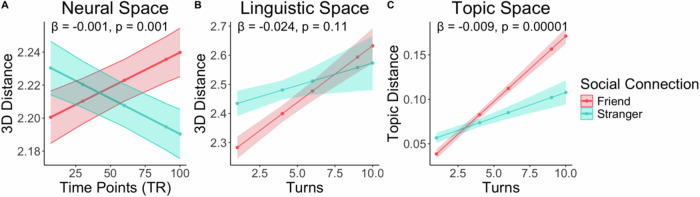
On the one hand, it is unsurprising that friends start out more similar to each other—they have a shared history and a familiar dynamic. But as conversations continued, being similar was not what characterized these pairs, and exploring new ground was a key ingredient of enjoyable conversations. Perhaps exploring different ground and changing topics carry some risk if you don’t know what the other person likes to talk about, which can make it harder to find topics that are more rewarding and enjoyable. Overall, this study suggests that finding common ground doesn’t capture the full picture of what makes a conversation enjoyable; exploration and novelty may play a bigger role in shaping good conversations than previously thought.
So next time you chat with someone, whether it’s an old friend you’ve known for years or someone you’re meeting for the first time, don’t just look for common ground. Embrace the twists and turns! They just might be what make your conversation unforgettable.
Additional References
(1) Kovacs, B., & Kleinbaum, A. M. (2020). Language-style similarity and social networks. Psychological Science, 31(2), 202-213.
(2) Parkinson, C., Kleinbaum, A. M., & Wheatley, T. (2018). Similar neural responses predict friendship. Nature Communications, 9(1), 332.
(3) Aron, A., Melinat, E., Aron, E., Vallone, R. & Bator, R. (1997). The experimental generation of interpersonal closeness: A procedure and some preliminary findings. Pers. Soc. Psychol. Bull. 23, 363–377.
Image Credit
- Featured image- Designed by Freepik
- Figure reproduced from Speer et al. (2024), Hyperscanning shows friends explore and strangers converge in conversation. Nature Communications, 15(1), 7781. Licensed under a Creative Commons Attribution-NonCommercial-NoDerivatives 4.0 International License http://creativecommons.org/licenses/by-nc-nd/4.0/. No changes were made.
 cogbites