Welcome back to our Cogbites interview series, where we talk with cognitive scientists about what inspires their work in the lab and beyond.
As a reminder, you can learn a little about our own team of contributors by reading their bios (either on our author page or at the bottom of each post), but this is a chance to get to know some early-career scientists even better. Last time, we got to know Colin McArdle, a fifth-year Ph.D. student in Neuroscience at Wake Forest University School of Medicine.

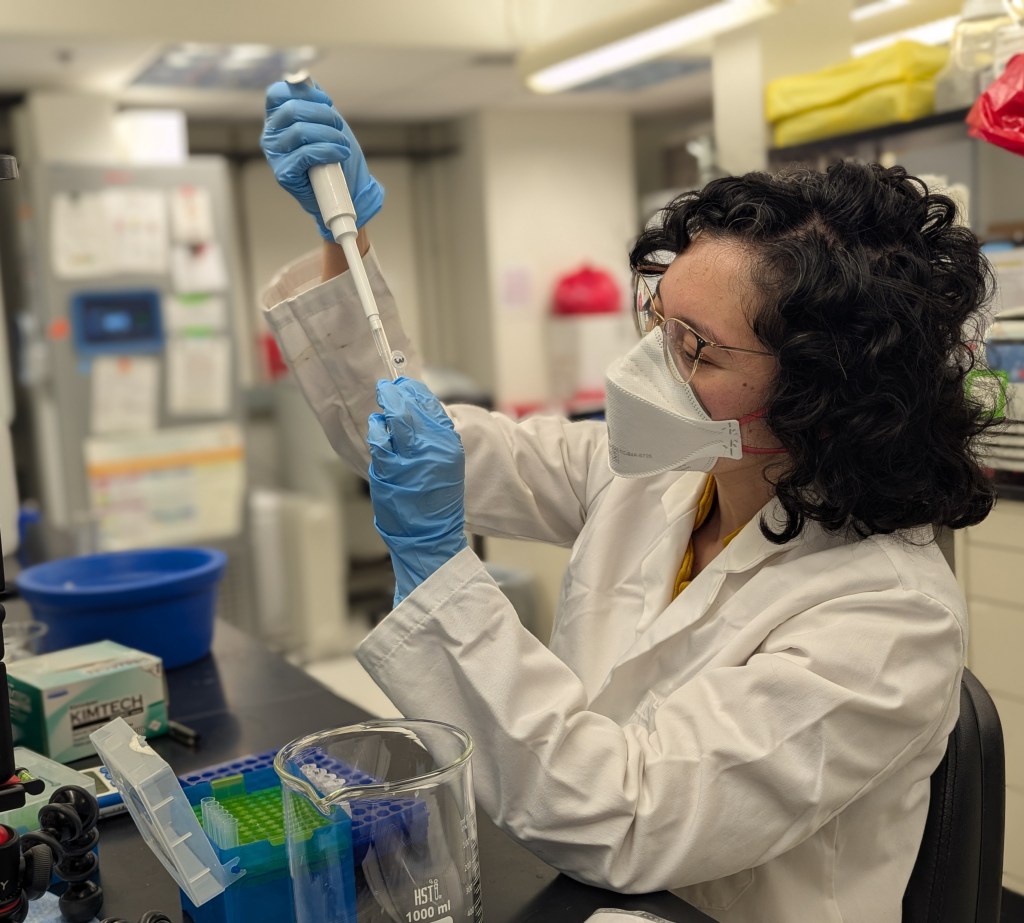
This week’s interview is with Lindsey Ramirez, a postdoctoral research scientist in Dr. Elizabeth Glover’s lab at the University of Illinois-Chicago. Lindsey’s research explores how alcohol impacts the brain and behavior, with a special focus on why some people find drinking more aversive than others. She’s also a Cogbites contributor—you may have read her post on how depression disrupts the brain’s reward system and can look forward to another article soon!
Without further ado, here’s our interview with Lindsey:
Why did you decide to pursue cognitive science?
I have been interested in addiction for a long time. I was always curious why some people develop addictions while others don’t, or why some people choose to seek help while others don’t. That led me to study behavior and the differences that shape it. Over time, I realized how much you can learn about behavior by studying cognitive processes, and that’s what ultimately pulled me into cognitive science.
What are you currently working on?
Right now, I’m investigating the brain mechanisms that underlie alcohol’s aversive properties. While most people know alcohol can be rewarding, it also causes sedation, negative mood, and impaired motor control. These aversive effects are important because they can actually help limit drinking, but not everyone experiences them strongly enough to cut back.
My work measures brain activity and gene expression in two regions—the prelimbic prefrontal cortex (PL mPFC) and the rostromedial tegmental nucleus (RMTg)—to see if they are involved in signaling these aversive effects. Understanding these differences could be key to identifying why some people drink more heavily than others.
What’s the most important concept in cognitive science?
For me, it’s learning. In our lab, many of our behavioral paradigms depend on the animals’ ability to learn. If animals don’t learn as expected, it can completely change how we interpret our results. That’s why it’s so critical to carefully control for learning in our experiments—it’s at the foundation of everything we study.
What sparked your interest in science communication?
I grew up watching science shows on TV, and they first sparked my love for science. But when I started graduate school, I found myself struggling to understand many scientific presentations. At first, I thought the problem was me—that I wasn’t cut out for a career in science. Eventually, I realized the issue wasn’t my ability to understand but the way the information was being presented.
That realization motivated me to improve science communication. I don’t want anyone else to feel discouraged the way I once did. Science should be accessible to everyone, no matter their background or education level. Now I use different media to communicate science through writing, videos, and even my own YouTube channel, The Clever Scientist, where I share tips on improving communication in presentations, manuscripts, posters, and more.
Is there anything else you want us to know about you?
Beyond research and communication, I love highlighting other scientists’ stories and projects (you can see some of my work here). Outside of science, I enjoy true crime and horror, and I can’t resist a good thrift find or garage sale bargain.
 cogbites
[…] researchers and learn more about their paths into cognitive science. Last time, we featured Lindsey Ramirez, a postdoctoral research scientist in Dr. Elizabeth Glover’s lab at the University of […]
LikeLike