Reference: Pagnini, F., Grosso, F., Cavalera, C., Poletti, V., Minazzi, G. A., Missoni, A., … & Bertolotti, M. (2025). Unexpected events and prosocial behavior: the Batman effect. npj Mental Health Research, 4(1), 57. https://doi.org/10.1038/s44184-025-00171-5
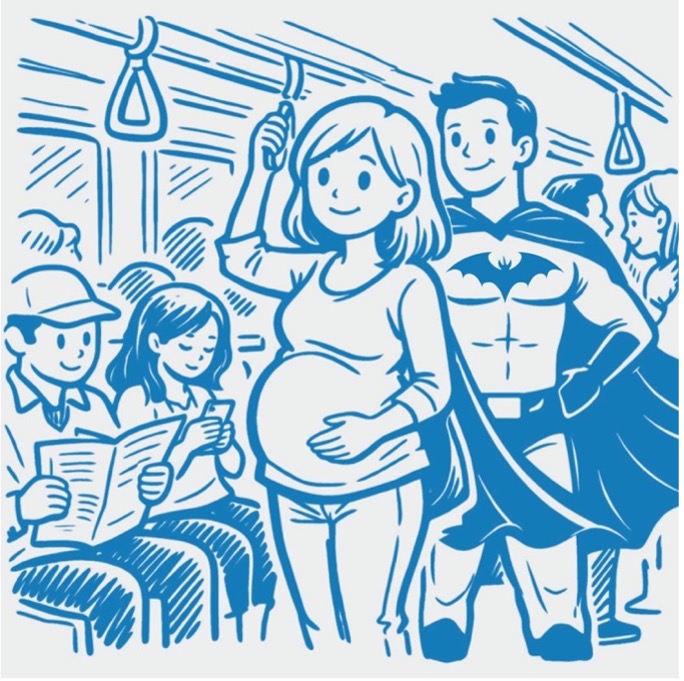
Have you ever given your seat up for someone less able to stand on public transport? It’s common courtesy that when we see a pregnant person, or someone elderly, we would offer them our seat. But in today’s world of AirPods and constant digital distraction, we might not notice the people in our surroundings that need our help.
Prosociality, the desire to help others, is a cornerstone of humanity. We act altruistically to fit in, to feel good about ourselves, or in the hope that others will be selfless in return. However, people act differently in solo versus group settings. Environmental cues and social dynamics also impact our behavior. You might be more motivated to show that you’re a good person in front of your friends or act kindlier to friends with whom you share many mutual connections (1).
In 2025, researchers in Italy carried out a study which took these ideas to explore how unexpected social situations influence situational mindfulness and prosociality. More specifically – can the presence of Batman convince people to give up their seats for a pregnant person?
Send up the Bat-Signal: How to Test the Effect of the Unexpected
The researchers used the Milan underground metro system as their laboratory. Their study had two conditions: a control with 70 trials and an experiment with 68 trials. The control had two people walk into a busy train carriage, with one wearing a fake pregnancy bump and the other dressed in plain, regular clothes. In the main experiment condition, one person still wore a prosthetic belly, but the other dressed as Batman – minus the mask so he didn’t appear threatening to passengers.
The researchers conducted both trial conditions at the same time, in different cars of the same metro train to avoid any influence of time or location on their results. There were two potential outcomes: the ‘pregnant’ woman was given a seat, or she was not.
‘Batman’s’ Influence on Prosociality
In the control condition, people gave up their seat to the pregnant experimenter in 37.7% of trials. However, with ‘Batman’ present, that percentage rose to 67.2%. This significant increase suggested that yes, the presence of ‘Batman’ – or at least the presence of a surprising event – can increase one’s likelihood of offering up a seat to a pregnant person.
In both conditions, the gender split and age of people offering their seats remained the same. Regardless of whether ‘Batman’ was present, women, and people in their early 40s were the ones giving up their seat most of the time.
Passengers who offered their seats were then asked why they did so. Across conditions most responded that they felt it was important to recognize pregnancy in other passengers. Remarkably, no passenger listed the presence of ‘Batman’ as a reason for giving up their seat. In fact, 43.7% of experiment-condition seat givers said they didn’t even see ‘Batman’ in the carriage.
Explaining the ‘Batman Effect’
The authors provide two potential explanations for the reasons why the presence of the Dark Knight made people more prosocial. First, Batman is a positive pop culture icon. He stands for chivalry and is commonly someone who we would want to emulate. The Batman impersonator may have therefore acted as a subconscious reminder to act altruistically.
A study from 2018 (2) suggests that viewing superheroes might make people more inclined to help others during tedious tasks. But a recent review (3) highlights a general problem with replicability in the field of social priming studies. So, we should be skeptical of the Batman impersonator’s ability to conjure prosociality by association.
Additionally, several participants reported not seeing ‘Batman,’ suggesting that surprising events in our surroundings – conscious or subconscious – can lead to heightened awareness of one’s surroundings. This is a departure from previous studies that imply that we need to be actively mindful to be more prosocial. Instead, something surprising simply entering our environment may be enough to engage mindfulness and elicit altruism.
What Does this Mean Practically for Prosociality?
Unfortunately, we can’t station a Batman impersonator on every train carriage to help those less able to stand. Instead, we need to find other ways to surprise people into prosociality. The researchers suggest that policy makers introduce ‘positive disruptions’: imagine purpose-made billboards or theatrical events that could shake us out of our routines and force us to re-engage with our surroundings.
The authors mention that in the future, research should be expanded to other cultures and transit systems. Batman is also a positive figure in pop culture, so using a surprise with a more negative connotation – perhaps the Joker? – may elicit different results.
There is more work to be done in this subfield of prosociality, but if you are a public-transit user, take this as your sign to give your seat to someone who needs it, regardless of whether Batman is there.
Additional References
(1) Curry, O., & Dunbar, R. I. M. (2011). Altruism in networks: the effect of connections. Biology letters, 7(5), 651-653. 10.1098/rsbl.2010.1202
(2) Van Tongeren, D. R., Hibbard, R., Edwards, M., Johnson, E., Diepholz, K., Newbound, H., … & Green, J. D. (2018). Heroic helping: The effects of priming superhero images on prosociality. Frontiers in Psychology, 9, 2243. https://doi.org/10.3389/fpsyg.2018.02243
(3) Mac Giolla, E., Karlsson, S., Neequaye, D. A., & Bergquist, M. (2024). Evaluating the replicability of social priming studies. Meta-Psychology, 8. https://doi.org/10.15626/MP.2022.3308
Image created with AI and modified on Canva
 cogbites