Reference: Merry, J. W., Elenchin, M. K., & Surma, R. N. (2021). Should students change their answers on multiple choice questions? Advances in Physiology Education, 45(1), 182–190.
Guest post by Malia Hardy
Imagine you are sitting in a classroom taking a standard multiple-choice exam. You choose an answer, but you are not totally confident in your choice. Still, you decide not to reexamine the other options because you “gotta go with your gut.” Did you make the right choice?
Research by Merry and colleagues would suggest you take another look. Their research shows that, despite the common belief among both faculty and students that changing your answer harms test performance, answer revision – when done thoughtfully – is more beneficial than detrimental.
Bad Perceptions and Where They Come From
“Go with your gut” is one of the most common pieces of test-taking advice. Many people believe that changing an answer increases the likelihood of going from a correct response to an incorrect one (i.e., right to wrong). This belief – that answer changing is harmful – stems from the instinct fallacy, the idea that one’s initial choice is the best choice and should not be reconsidered.
In test-taking, this perception is likely reinforced by memory biases. People tend to remember negative outcomes more vividly than positive ones, making students more likely to remember the one time they changed their answer from right to wrong while overlooking the many times they have changed their answer from wrong to right. Merry and colleagues further note that perceptions surrounding answer changing may be shifting, as students and educators are increasingly exposed to research suggesting that answer changes can, in fact, be beneficial.
To investigate whether these perceptions have changed, Merry and colleagues distributed an online questionnaire to faculty and students at Saint Francis University. These participants were asked whether they believed that changing answers on exams generally benefits or harms student performance. Despite a substantial body of research indicating the benefits of answer changing, most faculty believed that it harms student performance. In contrast, students were more likely to believe that changing answers could improve their scores. Because many faculty members held negative views about answer changing, students were rarely instructed to reconsider their initial responses.
This discrepancy raises an important question: Are faculty perceptions justified? Or could the longstanding advice to “stick with your gut” be misguided, despite its intuitive appeal?
The Benefits of Just Checking
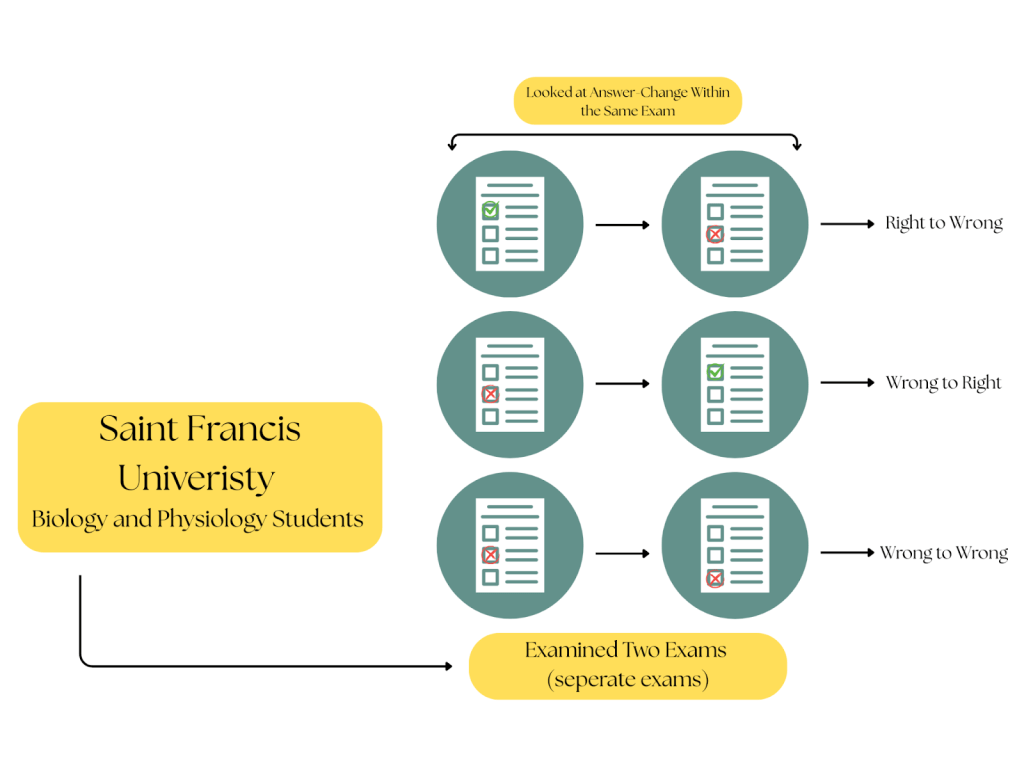
After examining faculty and student perceptions, Merry and colleagues turned to a more direct test of this central question: Does reconsidering one’s answer actually improve performance? To address this question, Merry and colleagues analyzed answer changes within two separate exams (Exam 1 and Exam 2) completed by biology and physiology students.
In a research laboratory, the exams were placed under a bright, direct light and examined for eraser marks or scratch-outs (indications of answer changes). Each change was categorized into one of three types: right-to-wrong, wrong-to-wrong, and wrong-to-right. This classification enabled the researchers to examine whether changes in responses tended to harm or benefit students’ scores.
Merry and colleagues found that, consistent with prior research, there were significantly more wrong-to-right than right-to-wrong changes, indicating that answer changing was associated with improved exam performance. Hooray, students for the win!
Take-Home Message
What does this mean for test takers? Should you stop trusting your judgment and always change your answers? Not quite. Taking a test can be stressful, and there are a lot of things going on in your brain to help you retrieve the correct answer. This research does not suggest that changing your answer indiscriminately will improve performance.
Instead, the key takeaway is simpler and more reassuring: There is no inherent harm in reconsidering your answers. When students do change their answer, they are more likely to correct and initial a mistake than to undo a correct answer. So next time you take a test, after you finish answering the questions, go back, reread the questions, look at the options, and ask yourself, “Do I want to keep this answer, or change it?” It is as simple as that.

Malia is a junior at Santa Clara University, studying psychology and child studies. Malia also works as a Department Coordinator for On-Campus Advocacy for Santa Clara Community Action Program. Outside of school, Malia enjoys volunteering in the community and staying connected with friends and family. After graduation, she aspires to attend graduate school, then earn her PhD in Educational Psychology or Educational Policy.
 cogbites