

Reference: Aguillon, R., Harduf, A., Sagi, D., Simon-Blecher, N., Levy, O., Appelbaum, L. (2026). DNA damage modulates sleep drive in basal cnidarians with divergent chronotypes. Nature Communications, 1-14.
The average person sleeps between seven and nine hours a night (1), usually at home, usually in bed. But what about animals such as cats, dogs, squirrels, insects, or even sea creatures?
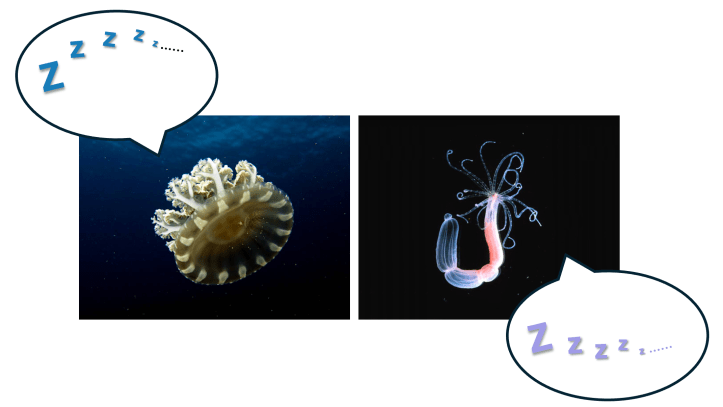
In a recent publication in Nature Communications, researchers at Bar-Ilan University investigated sleep in two unusual animals: the upside-down jellyfish and the sea starlet anemone. These species are evolutionarily ancient and existed long before the evolution of a centralized brain. Instead of a brain, they possess a neuronal ensemble—an interconnected network of neurons that functions more like a diffuse web than a single control center(2).
How do researchers know when a jellyfish is sleeping?
Sleep is costly. When animals sleep, they cannot perform other behaviors essential for survival, such as eating or reproducing. They are also more vulnerable to predators. Yet the researchers found that both species slept for about one-third of the day (roughly the same proportion of time that humans spend sleeping!) This finding suggests that sleep itself may be at least 600 million years old, dating back to when these species diverged.
To determine when the animals were asleep, researchers tested how quickly they responded to stimulation. At different times of day, they shot small pulses of water at the animals. If the animal responded quickly, it was considered awake; if the response was slower, it was classified as asleep. Using this method, the researchers discovered that the upside-down jellyfish is nocturnal (active at night), whereas the sea starlet anemone is diurnal (active during the day).
Despite these very different chronotypes, both species naturally released melatonin, a hormone that promotes sleep, during their resting periods. When researchers artificially increased melatonin levels, the animals slept more, even during times when they are normally awake.
DNA damage during sleepless nights
Medical research increasingly shows that sleep deprivation is linked to serious health problems in humans, including neurodegeneration, cancer, immune dysfunction, and cardiovascular disease (3). One common risk factor across many of these conditions is genomic instability—damage to DNA within cells (4). With this in mind, lead author Aguillon and colleagues asked whether sleep deprivation might also cause DNA damage in jellyfish and sea anemones.
To test this idea, the researchers used a tool developed in the 1990s: an antibody that binds to damaged DNA and fluoresces under a microscope (5). By measuring fluorescence levels across samples, they found that both jellyfish and anemones showed higher levels of DNA damage after a night without sleep.
The team then took the experiment a step further. They deliberately damaged the animals’ DNA using ultraviolet (UV) radiation, essentially exposing them to a process similar to a tanning bed for marine organisms. After confirming that DNA damage had occurred, the researchers monitored the animals’ sleep behavior. The organisms slept significantly longer following the UV exposure, suggesting that sleep may help repair DNA damage.
Together, these findings indicate not only that sleep deprivation and DNA damage are closely linked, but also that sleep itself may play a restorative role, helping organisms repair the cellular damage accumulated during waking hours.
So why do we sleep and how did sleep behavior evolve?
Sleep appears to be so ancient and fundamental that it may not even require a brain. The findings from this study suggest that sleep existed long before centralized nervous systems evolved. Based on their results, the authors propose that sleep may have evolved as a biological mechanism for repairing DNA damage caused by everyday environmental stressors.
Our bodies rely on many homeostatic, or self-regulating, processes to maintain balance. For example, we sweat when our body temperature rises, regulate blood pH within a narrow range, and activate immune responses when bacteria or viruses enter the body. These systems help protect us from harm and keep our internal environment stable.
Sleep may represent another such homeostatic process. Although more research is needed to confirm this idea, the evidence suggests that sleep could function as an evolutionarily conserved repair system, one that helps organisms restore cellular integrity and prevent disease. If so, sleep would not simply be a period of rest, but a deeply rooted biological strategy that has been refined over hundreds of millions of years to maintain health and survival.
Additional References:
- https://ccr.cancer.gov/news/landmarks/article/h2ax-as-a-sensor-of-dna-damage
- https://www.webmd.com/sleep-disorders/sleep-requirements
- Sherrington, CS. (1906) The Integrative Action of the Nervous System. New York: Charles Scribner’s Sons.
- https://www.thelancet.com/journals/landia/article/PIIS2213-8587(24)00132-3/fulltext
- https://pmc.ncbi.nlm.nih.gov/articles/PMC6693886/
 cogbites