Welcome back to our Cogbites interview series, where we chat with cognitive scientists about what inspires their work—both in the lab and beyond.
As a reminder, you can learn more about our team of contributors by reading their bios on our author page (or at the bottom of each post). This series gives us the chance to spotlight early-career researchers and learn more about their paths into cognitive science. Last time, we featured Lindsey Ramirez, a postdoctoral research scientist in Dr. Elizabeth Glover’s lab at the University of Illinois-Chicago.
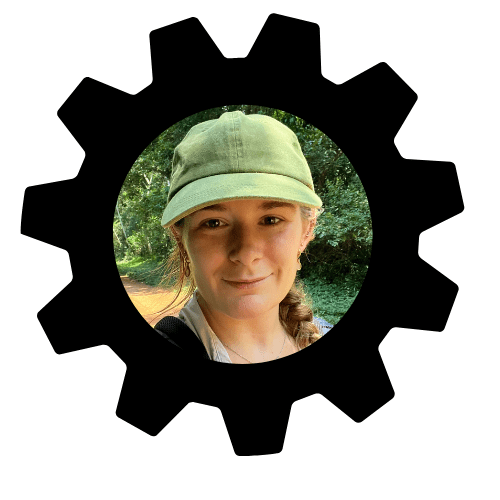
This week’s interview is with Eloise Pedersen, a fifth-year PhD candidate working with Dr. Craig Stanford in the Human and Evolutionary Biology Department at the University of Southern California. Eloise is due to graduate in May 2026 (yay!), and her research bridges comparative cognition and evolutionary biology, focusing on how both chimpanzees and young children learn from others.
Eloise is also a Cogbites contributor. You may have read her article on capuchin monkey metacognition, and she’s currently working on a new piece exploring how environmental surprise shapes prosocial behavior.
Without further ado, here’s our interview with Eloise:
Why did you decide to pursue cognitive science?
I began my university career in biological anthropology where I discovered a love for primate behavioral research. In many ways I’m still a biological anthropologist, in that I’m interested in understanding how and why aspects of cognition and behavior evolved. I’ve always loved learning about the way other animals think, and over time my research has moved from only behavior to cognition. Now I’m fortunate enough to research cognition in both humans and animals.
What are you currently working on?
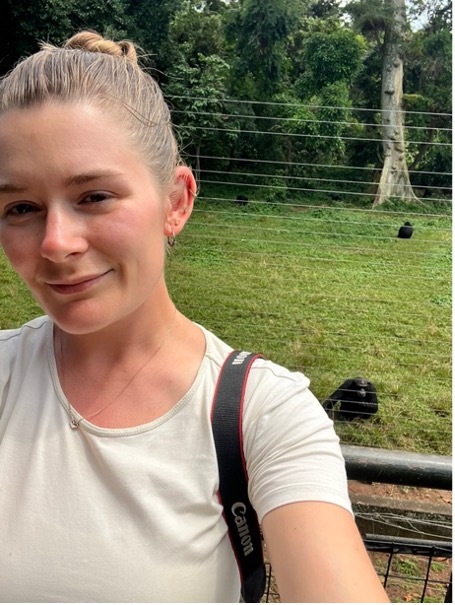
Right now, I’m working on my PhD thesis! I’m in the process of writing and submitting several papers for peer review based on a suite of studies I conducted at Ngamba Island Chimpanzee Sanctuary and in the UK, in collaboration with Durham University.
In these studies, I gave chimpanzees and 3-to-7-year-old children the opportunity to learn how to solve novel foraging tasks by observing two potential demonstrators with different characteristics. For example, in one chimpanzee study, one demonstrator was high-ranking but performed a behavior that earned a less-preferred reward (a piece of carrot), while another demonstrator was lower-ranking but earned a more-preferred reward (pineapple). By comparing who participants choose to copy, we can better understand whether social learning is driven more by outcomes or by demonstrator traits.

What’s the most exciting concept in cognitive science?
In comparative cognition, there’s one study from Kyoto University that I always come back to. In the task, a chimpanzee watches numbers from 1 to 9 briefly appear on a screen before they’re covered by white blocks. The chimpanzee then has to select the blocks in numerical order. Remarkably, chimpanzees can easily outperform humans on this task.
I love this study because it’s a powerful reminder that humans aren’t the pinnacle of cognition. Other animals can be far more capable than us in certain cognitive domains, and comparative research helps us appreciate the diversity of cognitive strengths across species.
What sparked your interest in science communication?
I’ve always loved writing, and while I enjoy my thesis research, I missed the constant exposure to new topics that I had when writing essays during my undergraduate degree. Through my work as a teaching assistant, I also realized how much I enjoy explaining scientific ideas to people with very different backgrounds. Science communication turned out to be the perfect intersection of my interests and strengths.
Is there anything else you want us to know about you?
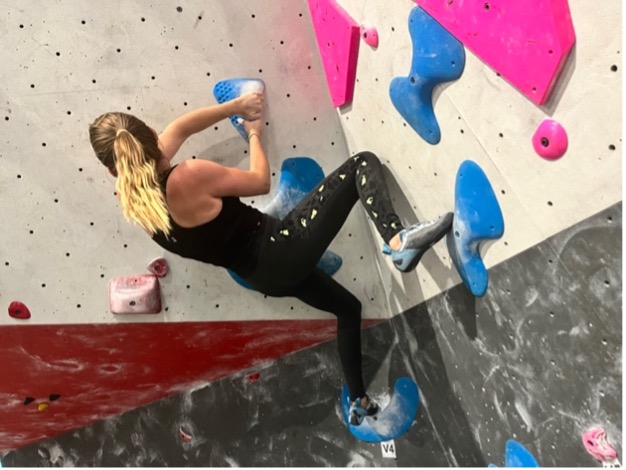
I tend to jump from hobby to hobby at an alarming rate! At the moment I’m enjoying rock climbing. Music is the one passion outside of science that I’ve stuck to for many years. I sing in a choir at USC, play the piano and guitar, and write and produce my own music.
 cogbites