Reference: Amoruso, L., Hernandez, H., Santamaria-Garcia, H., Moguilner, S., Legaz, A., Prado, P., Cuadros, J., Gonzalez, L., Gonzalez-Gomez, R., Migeot, J., Coronel-Oliveros, C., Cruzat, J., Carreiras, M., Medel, V., Maito, M. A., Duran-Aniotz, C., Tagliazucchi, E., Baez, S., García, A. M., & Ibanez, A. (2025). Multilingualism protects against accelerated aging in cross-sectional and longitudinal analyses of 27 European countries. Nature Aging, 5(11), 2340–2354.
As I stood in front of the cashier and struggled to remember the word for water, I thought “something must be wrong.” I could almost sense the early-onset dementia this experiment was going to cost me. “Was it worth it? Was it worth trying to revive your third language?” A voice inside of me mocked.
I had been in Mexico for two weeks, and whatever vestiges of Spanish my brain had managed to preserve from childhood were now being put through the ringer. My Spanish felt rusty, immobile. And that immobility had somehow spread to my other languages as well. Every day, I’d inadvertently embarrass myself, accidentally blurting out untranslatable sayings or suddenly forgetting a word I trusted myself to know. In the evenings, I’d dial my dad and sit in silence, my brain unable to decide what language to use.
Being multilingual does not always feel like the gift it is meant as. Between struggling to maintain a cultural identity and managing entirely different sets of vocabulary, it can feel like you’re being betrayed by your own brain. The brain farts, the mixups, the how do you says — there are plenty of reasons for a multilingual individual to cry dementia. I know I do. Yet, modern data shows multilingualism is linked to healthier aging and lower risk of dementia. Scientists believe this effect is mediated through cognitive reserve, a concept linked to the brain’s ability to adapt to damage.
What is cognitive reserve?
In 1988, a group of scientists was conducting Alzheimer’s disease research (1). They were doing cognitive tests and studying brain structure in aging nursing home patients. The goal was to see if scores on mental ability assessments correlated with the level of damage seen in the patients’ brains after death. For most patients, they did.
Yet, one group of patients defied that pattern. They did very well on the cognitive tests — often better than healthy people with similar profiles— but their brains looked like they had been gnawed at by dementia. The pattern-breaking patients shared some features: they possessed more neurons and heavier brains. The scientists hypothesized that these more developed brains were able to buffer damage by drawing on a kind of “reserve”.
Cognitive reserve is commonly used to refer to our brain’s ability to compensate for structural damage without showing any outward pathology. If a person’s brain shows signs of dementia, yet their behavior does not — we might attribute that gap to cognitive reserve.
Cognitive reserve defines our brains’ efficiency, flexibility, and adaptability. These features can’t be measured directly, so scientists approximate them using indicators such as education, physical activity, and IQ. As these factors build up neurobiological capital, they create a mental buffer.
This becomes important in aging. As we grow older, our brains physically shrink. We lose neuronal connections, and with them, our processing capabilities and speed. A rigid, unorganized system of networks might become paralyzed if it loses few key connections. A grid of well-interconnected networks, however, can adapt by utilizing many alternative pathways. These flexible networks are what we strive for in healthy aging. They are the ones that build cognitive reserve.
How multilingualism contributes to cognitive reserve
Recent science shows that multilinguals do not flip a switch when they need to change languages. Instead, all their languages are constantly competing for the spotlight, and it is their brain’s responsibility to keep the unnecessary ones off the stage.
As you might imagine, this takes consistent, arduous precision. With time, this mental pressure rewires the brain. Faced with increased demand, multilinguals’ language control and memory networks grow more developed and more efficient.
Coincidentally, these are also the networks most sensitive to aging and neurodegenerative damage. When Alzheimer’s starts consuming the brain, it usually eats away at the memory centers first. Because these regions are more robust in multilinguals, they can take more punches before a cognition “tipping point” is reached.
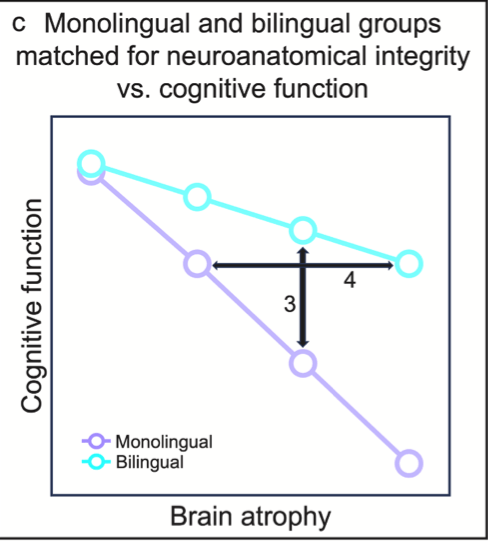
Studies of Alzheimer’s disease show that when multilingual and monolingual patients with similar symptoms are compared, multilinguals’ brain scans often show more extensive pathology (2). So, more damage is required for multilinguals to reach the same degenerative mental state.
The pattern also runs in reverse: when people are matched based on brain scans, multilinguals perform better on tests of executive function.
The multilingual advantage in healthy aging
Most research on multilingualism in aging tries to answer whether it can help a brain that is already failing. It can. But in theory, the multilingual advantage should apply to healthy aging too. A global team led by Dr. Agustin Ibanez decided to test that theory.
The scientists used the concept of biobehavioral age gaps–the difference between a person’s chronological age and their predicted biological age–to assess multilingualism’s effects on aging.
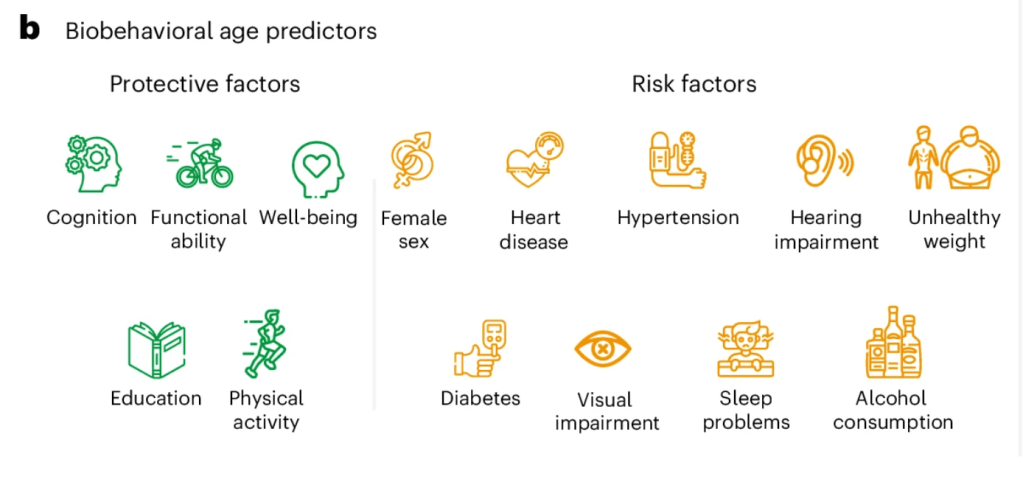
Some factors, like education and physical activity, contribute to slower cognitive aging. Others, such as being female or having a cardiac condition, increase the risks. Taken together, these factors can interact to estimate one’s age. If a person is younger than their risk factor calculation predicts, they are aging at an accelerated speed. If they are older — they are experiencing delayed aging.
Over 86,000 people from 27 European countries contributed their data to the study. While monolinguals succumbed to accelerated aging, multilinguals were 2.17 times less likely to experience it. The protective effects increased with the number of foreign languages a person spoke.
The protective effect of knowing one foreign language diminished in older age groups. Meanwhile, the effect of speaking two or more foreign languages became more pronounced.
The way our brains store languages might be responsible for this discrepancy. Each additional language demands more executive and memory capacity. The demands are met by growing mental infrastructure. The infrastructure contributes to cognitive reserve. The more languages a brain stores, the more resilient it becomes.
No growth happens effortlessly. Multilingualism develops networks precisely because it is difficult. Because it shows our brain that the infrastructure it already has is insufficient. And then forces it to learn new patterns and pave new routes.
You try, you fail, you accidentally say you’re pregnant instead of apologizing for already being embarrassed, you call up a phone number and say nothing, you try again. Each day, without the benefit of long-term perspective, may feel like a failure. But one connection at a time, you build something.
That something — the very same one that causes you to impulsively mistranslate a saying when you get too caught up in your own excitement — nurtures resilience. It boosts your cognition and it may grant you the gift of a better quality of life.
Additional References
- Katzman, R., Terry, R., DeTeresa, R., Brown, T., Davies, P., Fuld, P., Renbing, X., & Peck, A. (1988). Clinical, pathological, and neurochemical changes in dementia: A subgroup with preserved mental status and numerous neocortical plaques. Annals of Neurology, 23(2), 138–144.
- Stevens, W. D., Khan, N., Anderson, J. A. E., Grady, C. L., & Bialystok, E. (2023). A neural mechanism of cognitive reserve: The case of bilingualism. NeuroImage, 281, 120365. https://doi.org/10.1016/j.neuroimage.2023.120365
Featured Image: Alexmogopro from Pixabay / 2024 https://pixabay.com/illustrations/ai-generated-brain-galactic-mind-8759907/

