

Reference: Hino, R., Umejima, K., Wada, N., Takei, W., Kawasaki, Y., & Sakai, K. L. (2025). Neural basis of linguistic factors involved in thought: an fMRI study with native signers. Frontiers in Psychology, 16, 1582136.
Many people envision thought as being orchestrated by their inner monologue, whether by narrating plans, deliberating on where to eat, or rehearsing conversations. Yet not everyone possesses this “inner voice” (1), and for the majority that do, this is only one part of our mental machinery. We also think in images (both 2D and 3D), abstractions, and much more. As such, when scientists investigate the relationship between language and thought, inner speech is typically not what is being assessed.
Researchers can ask many questions about this relationship, including whether language shapes or supports the way we think. However, in this research study by Hino and colleagues (2025), the question was more specific: when people engage in nonverbal reasoning, does the brain recruit some of the same systems it uses to understand language?
Testing thought with and without spoken words
The researchers studied 18 participants exposed to Japanese Sign Language (JSL) from birth and acquired JSL as their first language. Twelve were deaf and also used written Japanese, while six spoke Japanese and used JSL to communicate primarily with their deaf parent(s).
Brain activity was measured using an MRI, including a popular “subtraction” method. Because any given task often requires the use of multiple cognitive faculties at once, it can be difficult to isolate the neural circuitry for one over the other. For instance, reading requires attention, language comprehension, visual processing, and more. Thus, if a scientist wanted to capture language comprehension, what they could do is collect activation data while a participant reads, then have them complete a separate visual task without words. The activation patterns from the visual task can then be “subtracted” from reading, ideally leaving only brain activity involved in language comprehension.
In the first experiment, participants completed 45 picture-based reasoning puzzles while in the scanner. The puzzles were divided into five sections: Context, Fill-in, Rotation, Sequence, and Analogy. On each trial, participants saw a visual cue and chose from three possible answers using a button press. The researchers designed the five sections to vary in how much they relied on language-like versus non-linguistic forms of thought.
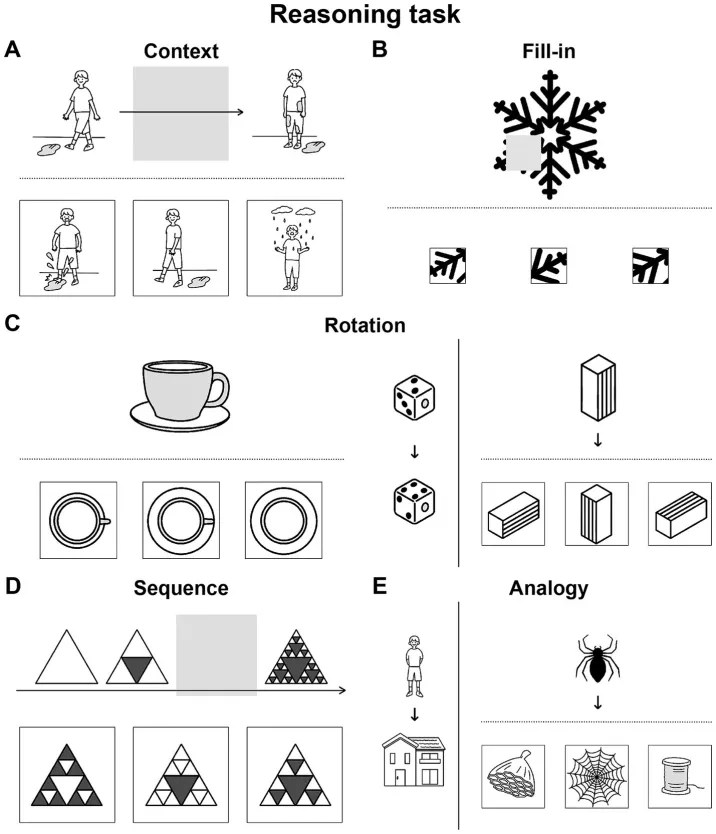
By linguistic forms of thought, the authors refer to a kind of mental operation that is characteristic of language, but not restricted to it. One example is recursive thought: the capacity to build a step-by-step structure by placing one idea inside of another, similar to a box inside a box. For instance, consider the statement “the boy, who saw the dog, that chased the cat, ran away.” The basic sentence is “the boy ran away.” From there, we can add more information inside, such as which boy (the one who saw the dog) and which dog (the one that chased the cat).
A second type is propositional thought, referring to understanding how one thing stands in relation to another. For example, in the sentence “the child chased the butterfly,” we understand that the child is doing the chasing and the butterfly is being chased. The final type was clausal thought, which involves organizing details into a complete event or situation.

In the second experiment, participants completed alternating sign and counting tasks. In the Sign condition, they watched videos of stories narrated in JSL and then answered questions using a button press. In the Counting condition, they watched the same videos but were instructed to ignore the story and count small circles that appeared briefly on the screen. This allowed the researchers to separate brain activity related to language comprehension from activity related to general visual attention.
What the imaging revealed
Because Fill-in was designed to rely most heavily on non-linguistic reasoning, the researchers used it as a comparison condition for the other reasoning tasks. The first major result came from subtracting Fill-in activity from the Context scan, which revealed greater activation in both the left lateral premotor cortex (L. LPMC) and the left inferior frontal gyrus (L. IFG), regions often associated with language production and grammar (2).

After repeating this by subtracting the Fill-in activation from the remaining conditions, the researchers compared the leftover activation for common neural signatures. They found that the Context, Rotation, and Sequence tasks, all believed to require recursive thought, shared activation in the L. LPMC/dorsal inferior frontal gyrus (dIFG) and the right lateral premotor cortex (R. LPMC).
The remaining activation in Context, Rotation, and Analogy, all proposed to involve propositional reasoning, shared activation in the left inferior frontal gyrus (L. IFG).
Importantly, these findings were not merely an artifact of task difficulty. Based on accuracy and reaction times, as Analogy was the easiest condition, whereas Rotation and Sequence were the hardest.
The second experiment with JSL served as an important reference point for interpreting these findings. Although some of the picture-based reasoning tasks were proposed to involve linguistic forms of thought, they did not use written or spoken words. Thus, the researchers needed an independent way to identify brain regions involved in actual language comprehension.
During the first JSL comprehension task, participants showed activity in several regions, including the L. IFG and bilateral posterior temporal gyri (pTG). When this activity was compared to the context reasoning condition, the researchers found overlap in these same areas. This finding suggests that at least some of the regions recruited during picture-based story reasoning were also recruited during genuine language comprehension.

Notably, pTG activity was not equally active across all reasoning tasks. Instead, it was selectively more active during the Context condition. The authors attributed this to the fact that Context required full event comprehension and involved all three proposed linguistic forms of thought. They interpreted this pattern as evidence for a clausal system.
Conclusion
So, is thought structured like language, or at least sometimes organized in a language-like manner? The study is certainly not conclusive. The sample size was modest, and because the task categories were theory-driven, the findings leave room for alternative interpretations from scientists working within different theoretical frameworks.
Still, the use of native signers makes this finding especially interesting, because active reasoning and thinking processes were complemented by language comprehension in the same visual modality. As such, the study raises an intriguing possibility: even when people solve a wordless picture puzzle, the brain may organize parts of that nonverbal reasoning in a language-like way, using systems that help represent events, relationships, and structure.
Additional References:
- Anendophasia: What It Is, Causes, Signs & Treatment
- Richard J.S. Wise, Fatemeh Geranmayeh, Chapter 60 – Sentence and Narrative Speech Production: Investigations with PET and fMRI, Editor(s): Gregory Hickok, Steven L. Small, Neurobiology of Language, Academic Press, 2016, Pages 751-762, ISBN 780124077942, https://doi.org/10.1016/B978-0-12-407794-2.00060-2.
Cover photo: Image by pencil parker from Pixabay

