Reference: Bieth, T., Decat, N., Kenett, Y. N., Scuccimarra, M., Ovando-Tellez, M., Lopez-Persem, A., Lacaux, C., Ben Younes, S., Le Coz, A., Moreno-Rodriguez, S., Arnulf, I., Volle, E., & Oudiette, D. (2026). REM sleep favors the restructuring of problem-related semantic associations. Communications Biology, 9, Article 1171. https://doi.org/10.1038/s42003-026-10354-1
Most of us have heard the saying: If you can’t solve a problem, try sleeping on it.
If you’re stuck on a tough problem or feeling blocked creatively, taking a break—and especially getting some sleep can help. But what really changes in your mind after you nap?
A recent study found that rapid eye movement (REM) sleep, a stage with high brain activity and vivid dreams, is linked to changes in how we connect ideas about a problem. However, making new connections doesn’t always mean you’ll find the answer. You can read study for more details.
Connecting the dots
Memory is more than just storing facts; it’s also about making connections. For example, the word “beach” might make you think of “sand” or “ocean,” but there are other, less obvious links too. Creative problem solving often means connecting ideas that don’t seem related at first. REM sleep might help by putting your brain into a state where it’s easier to link distant ideas.
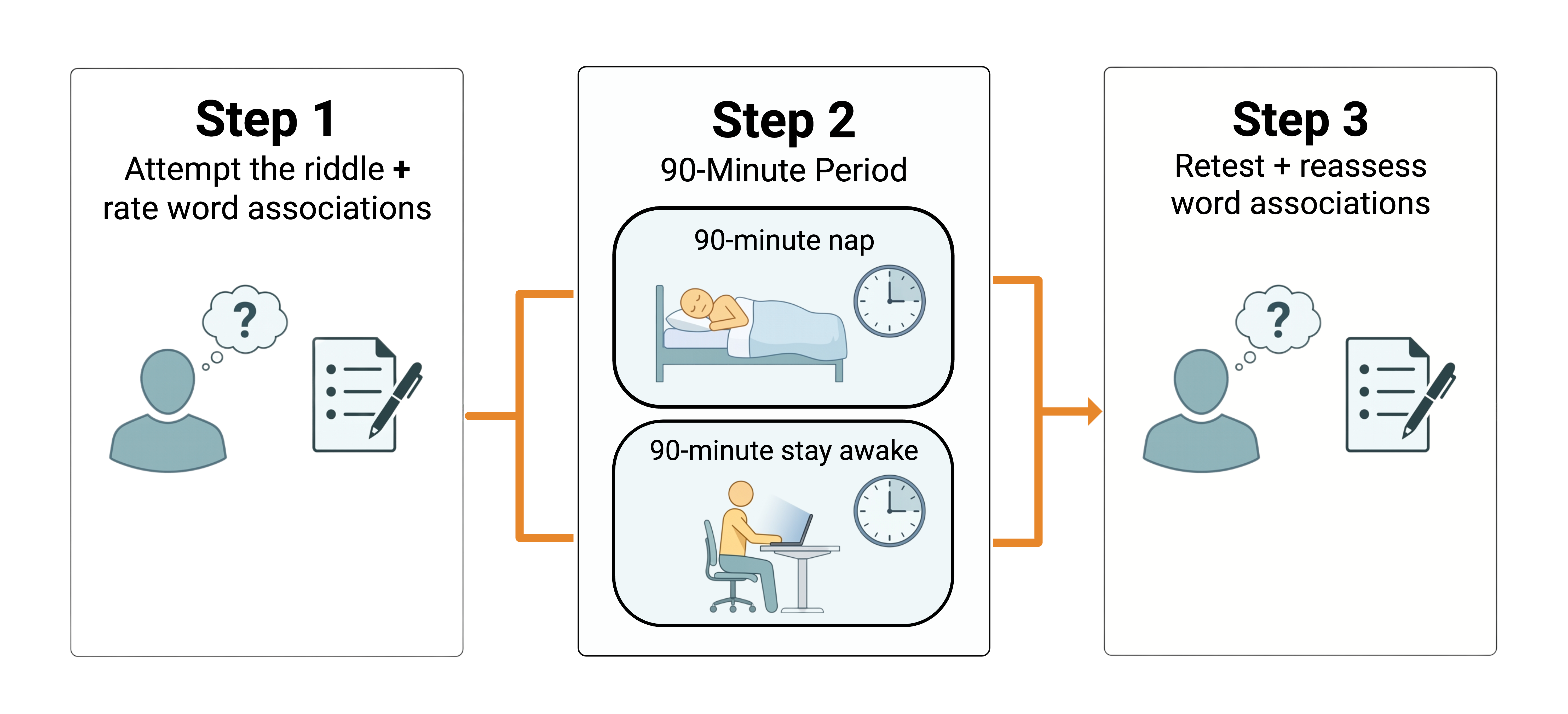
Researchers tested this idea with 111 young adults using a riddle: Zoe throws a stone that lands in the sky. How is that possible? The catch is that “sky” here doesn’t mean the sky above us; it’s actually the last square in French hopscotch. Solving the riddle means letting go of the most obvious meaning.
After trying to solve the riddle, participants took a 90-minute break. Some took naps, while others stayed awake. The researchers tracked who entered REM sleep. They also measured whether participants solved the riddle and how strongly they connected pairs of words related to it. These ratings helped build semantic networks, which you can imagine as mental maps where each idea is a point and the lines show how closely you connect them.
By comparing these mental maps before and after sleep, the researchers could see if the way people organized ideas about the problem changed.
This is where REM sleep made a difference. After REM sleep, ideas that were only loosely connected became more closely linked. REM also helped people move away from the obvious but incorrect answer. It seemed to break old mental habits, making it easier to form new connections.
So, should you sleep on it?
But there’s an important difference: REM sleep changed how people thought, but it didn’t make them more likely to solve the riddle. In the study, 20% of the wake group, 5% of the non-REM group, and 11% of the REM group found the answer. Even though these numbers varied, the researchers didn’t find a statistically significant difference in solving the riddle between the groups. In other words, changing your associations and finding the answer are not the same thing.
So, REM sleep doesn’t give you instant breakthroughs. But it might help your brain look at a problem differently. Bigger changes in how participants connected words were linked to more complex brain activity during REM sleep. This suggests that something unique happens as the brain reorganizes information while you sleep.
Your sleeping brain may be doing more than resting
This study gives us a more detailed look at the old advice to “sleep on it.”
REM sleep might not give you the answer, but it can quietly change how you search for it by helping you make new connections and let go of old ones. Creativity isn’t always about sudden insights. It often begins with seeing a problem in a new way. Sleeping on a problem can shift the connections you use, even if you don’t find the answer right away.
Images:
(1) Methods summary illustration was created using BioRender: https://www.biorender.com/

