
Reference: Mingolo, S., Prpic, V., Cipora, K., Bilotta, E., Mariconda, A., Agostini, T., & Murgia, M. (2026). Ace in the hole: playing cards show the role of order and magnitude in the SNARC effect. Psychological Research, 90(2), 69. https://doi.org/10.1007/s00426-026-02288-4
I usually play Rook every Sunday at a friend’s house. When I first learned the game, they suggested arranging my hand with point cards to the right and non-point cards to the left. When I picked up my hand and automatically began sorting my cards, I placed the lower number cards on the right and higher numbers on the left. What if this simple choice reveals something about how we understand numbers? Researchers have spent decades studying why people connect small numbers with the left side of space and larger numbers to the right.
What is the SNARC effect?
People often respond faster to smaller numbers with a left button and larger numbers with a right button. This pattern is called the SNARC effect (Spatial-Numerical Association of Response Codes; Dehaene et al., 1993). One explanation is that we mentally organize numbers along a line running from left to right—but researchers still debate what creates this association. For example, do we associate two with the left because it is smaller than eight (magnitude), or because two comes before eight in the counting sequence (order)? These associations may also reflect culturally learned habits, such as reading and writing from left to right. Although several explanations have received empirical support, separating order from magnitude has been challenging because numbers have both properties. Two will always come before eight and will always be less than eight.
Magnitude versus Order
In Ace in the Hole: Playing Cards Show the Role of Order and Magnitude in the SNARC Effect, researchers introduced a creative solution to separating order and magnitude. Rather than manipulating numbers themselves, they used playing cards to investigate whether order or magnitude plays the larger role in spatial-numerical associations.
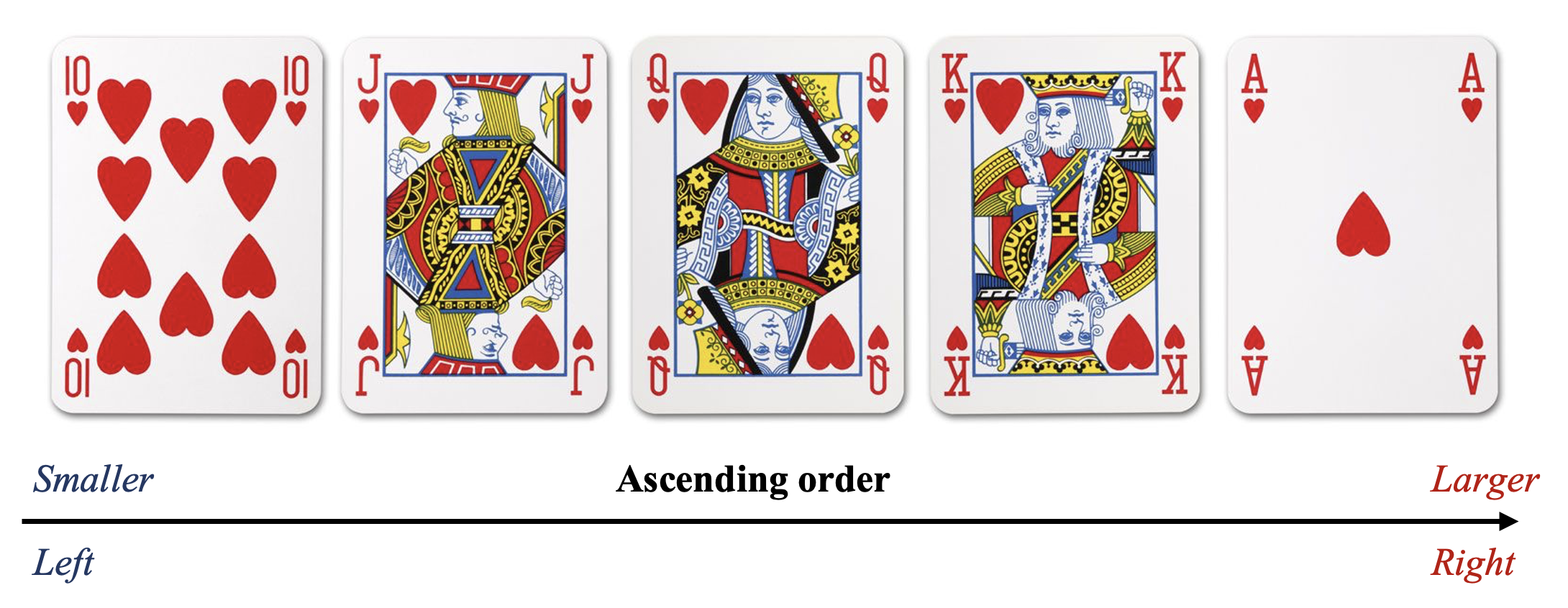
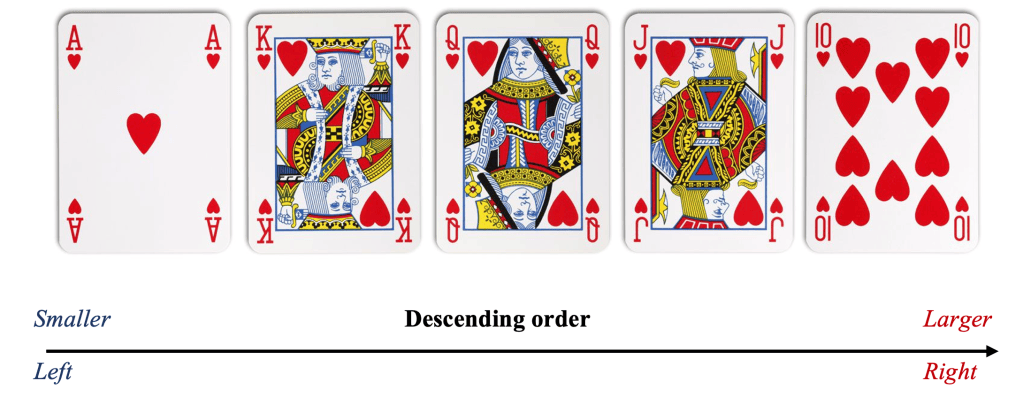
Putting Card Order to the Test
To pull order and magnitude apart, researcher Serena Mingolo and colleagues first had to find people whose card habits already did the work for them. Most people arrange cards in ascending order, low to high, left to right, matching a regular number line. However, there are people, like me, who consistently arrange them in descending order, high to the left and low to the right. For people who arrange cards in descending order, card order and card magnitude point in opposite directions. That conflict is what let the researchers pit order against magnitude and see which one wins.
Participants completed two tasks on separate days. In one, they saw numbers and judged whether each was smaller or larger than five. In the other, they made the same judgment about playing cards. By switching which response key meant “smaller” or “larger,” the researchers could test whether participants responded more quickly when smaller values were paired with the left hand and larger values with the right hand, compared with the opposite pairing.
An unexpected result
In Experiment 1, the researchers tested 56 people who naturally arranged their cards in descending order. When these participants judged ordinary numbers, they showed the expected SNARC effect. However, when they performed the same task with playing cards, the SNARC effect disappeared. It did not reverse, which you might expect if their preferred descending card order determined their spatial associations. Instead, the researchers were left with two possibilities: either card order was quietly fighting magnitude to a draw, or the playing cards as stimuli made the effect harder to detect.
Experiment 2 tested the second possibility. This time, researchers tested 71 people who naturally arranged their cards in ascending order. These participants showed a normal SNARC effect for both ordinary numbers and playing cards, suggesting that playing cards could produce a SNARC effect. The unusual result from Experiment 1 seemed related to the conflict between descending card order and the usual left-to-right representation of numbers. However, researchers still needed to explain why the SNARC effect disappeared for the descending order participants in Experiment 1. So, they tried again.
Experiment 3 replicated the descending order group online, and this time, the SNARC effect reappeared for both numbers and cards. Even though these participants habitually held their cards high to low, they still associated small card values with the left and larger with the right. The three experiments point toward magnitude having the upper hand over order.
The three experiments point toward magnitude having the upper hand over order. But there was a wrinkle: the descending-order participants in Experiment 1 had more card-playing experience than the ones in Experiment 3. Interestingly, greater card-playing experience was associated with weaker spatial associations for playing cards, but not for ordinary numbers. This suggests that everyday experiences may shape how we mentally organize information within particular contexts.
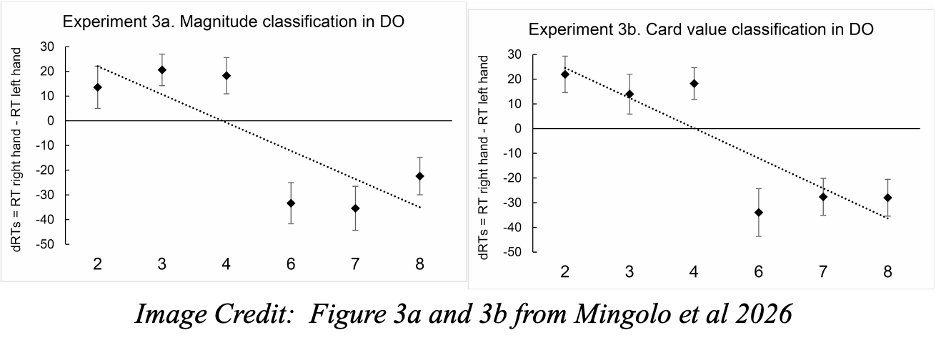
Cards on the Table
In these tasks, magnitude seemed to have the upper hand. Even when participants regularly arranged their cards from right to left, they still tended to associate smaller card values with the left and larger with the right. The researchers found no evidence that descending card order actually reversed the SNARC effect.
Why might magnitude-based associations persist even when someone has years of experience arranging cards in the opposite direction? Two theoretical perspectives offer possible explanations. First, A Theory Of Magnitude (ATOM; Walsh, 2003) suggests that our brains process the size of things, such as numbers, time, and space, in a shared mental system. For numbers, this can produce a mental number line in which smaller values are associated with the left and larger with the right. CORrelations in Experience (CORE; Pitt & Casasanto, 2020) takes a different approach, emphasizing that people’s experiences shape how they organize information in space, but not all experiences have the same influence. For example, repeatedly placing high value cards on the left and low value cards on the right could reinforce that mapping but it may conflict with the familiar left-to-right number line. Card-playing habits might therefore weaken the usual association without fully reversing it.
Conclusion
And this brings me back to my Rook hand. My instinct to arrange my cards from high to low does not necessarily mean that I picture numbers backwards. As the study suggests, our mental number line is shaped by similar number-space associations that can persist even when our card-playing habits point in the opposite direction. I may have simply learned a separate way of organizing numerical information that I use when I am holding cards.
Additional References
Dehaene, S., Bossini, S., & Giraux, P. (1993). The mental representation of parity and number magnitude. Journal of Experimental Psychology: General, 122(3), 371–396.
Pitt, B., & Casasanto, D. (2020). The correlations in experience principle: How culture shapes concepts of time and number. Journal of Experimental Psychology: General, 149(6), 1048–1070. https://doi.org/10.1037/xge0000696
Walsh, V. (2003). A theory of magnitude: common cortical metrics of time, space and quantity. Trends in cognitive sciences, 7(11), 483-488.

