
The effects of particulate matter exposure on cognition
Reference: Azab, S. M., Anand, S. S., Doiron, D., Schulze, K. M., Brook, J. R., Brauer, M., … & de Souza, R. J. (2026). Association of air pollution with brain health: A cross-sectional analysis in adults living in Canada. Stroke.
Imagine this: you grab your morning coffee and walk out onto the deck. A wide sea of green opens up in front of you as you take a deep breath and let your lungs fill with crisp morning air. A bird caws in the distance, you hold your breath for a couple of seconds before letting go of the moment. You slowly pull in another breath. Your mind clear, agile, you look towards the day ahead.
Now, imagine you try doing the same thing while living next to a freeway. Four lanes each way, a dust-covered barrier with dead grass in the middle divides the opposing lanes of traffic. An old truck coughs out a cloud of black smoke, trash bags roll over the traffic barrier and cling to your legs. You try to draw in the air, but the dust immediately tickles your nose and envelops your throat. You sneeze: one, two, three. No peace, but fogginess and mild irritation, you retreat back inside, barricading all windows.
While it is easy to guess that the second scenario would be much worse for one’s health, recent findings suggest that even mild air pollution, commonly observed across most cities around the globe, can negatively affect us. Specifically, research shows that even relatively low levels of air pollution can result in faster cognitive aging and worse performance on cognitive tests.
Air pollution
Air pollution comes from any agent that alters the natural atmosphere and thus contaminates it. One of the major air contaminants is particulate matter, commonly referred to as PM. Comprised of a mixture of tiny particles, PM is closely linked to human activity, often originating from fuel combustion or dust from mining and erosion.
Because the exact particle composition of PM differs, it is usually defined based on the size of the particles rather than their chemical identities. PM10 includes particles less than 10 micrometers in diameter, like pollen and dust. PM2.5 consists of particles that are smaller than 2.5 micrometers. Their small size allows them to penetrate more deeply into the lungs and potentially enter the bloodstream.
Particulate matter and the brain
We’ve known for a long time that extreme levels of air pollution can lead to serious health problems: The World Health Organization (WHO) estimates that outdoor air pollution caused 4.2 million premature deaths worldwide in 2019 alone. Meanwhile, epidemiological research and mouse studies have also linked high levels of air pollution to dementia. However, scenarios outside of the extremes are rarely studied. Recent research by Dr. Azab and her team at McMaster University suggests that cognitive ability might suffer even from pollution levels that were previously considered safe.
The researchers took data from a pre-existing cohort that recruited adults from 2014 to 2018 and calculated their PM exposure for five years prior to recruitment. The team back-estimated the exposure by matching satellite data on PM2.5 concentration for a given area to the residential zip codes of the participants. As a secondary measure, they also looked at the participants’ levels of exposure to NO2, which is another common pollutant, often linked to traffic exhaust.
The scientists then compared levels of exposure to scores on two cognition tests commonly used to screen for cognitive decline: the Montreal Cognitive Assessment (MoCA) and the Digit Symbol Substitution test (DSST). The MoCA allows scientists to look at delayed recall, verbal fluency, visuospatial skills, and executive functioning. Because it assesses a range of cognitive abilities, the MoCA is especially attuned to detecting changes in cognition associated with the transition from normal cognition to mild cognitive impairment and early dementia.
Meanwhile, the DSST is often used in international studies to measure motor speed, attention, visuoperceptual functions, and working memory as it relies on abstract symbols and numbers rather than words. Together, the tests are often used in clinical settings to quickly screen for cognitive deficits. In addition to measures of cognition, the team also used MRI scans to assess vascular brain health.
After analysing data from nearly 7,000 adults, the scientists concluded that greater exposure to PM2.5 and NO2 was associated with lower scores on both the MoCA and the DSST. While the average level of PM2.5 exposure was 6.9 μg/m3, every 5 μg/m3 increase in exposure resulted in scores that were 0.44 and 1.31 points lower on the MoCA and DSST, respectively. These lower scores were statistically equivalent to the differences in cognitive scores associated with 12.6 years of cognitive aging on the MoCA and 1.9 years on the DSST.
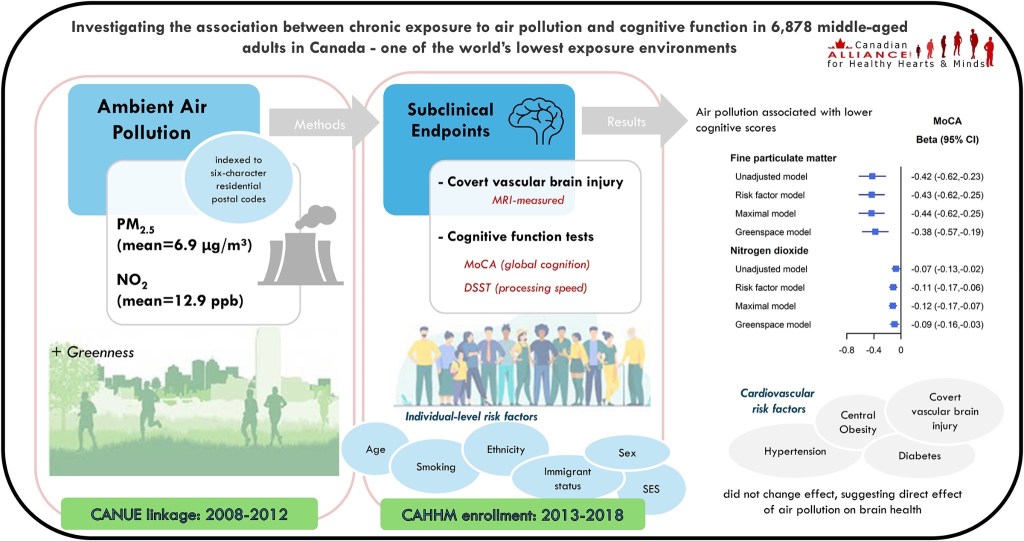
To figure out what underlies this relationship, the team tested multiple potential mediators and found that none, including access to greenspace and cardiovascular health, were able to explain the change in cognition by themselves, suggesting that these factors did not independently account for the association and that other biological or environmental mechanisms may be involved.
How particulate matter damages the brain
Scientists believe PM2.5 enters the brain by two pathways: through the olfactory bulb and through the bloodstream. The olfactory bulb is the relay station between nerves and higher processing centres of the olfactory system: it collects information from primary olfactory neurons in the nose, processes it, and sends it to higher regions for analysis. Because primary olfactory neurons have to be exposed to the environment to collect data, they can become victims of PM, which then uses them to get to the bulb, and from there — to other areas of the brain.
Alternatively, smaller particles can get to the brain through the circulatory system. When inhaled, the particles follow the other molecules to alveoli, the tiny air sacs within the lungs, which are closely entwined with capillaries. Some particles may pass from the alveoli to the capillaries and freely enter the bloodstream, which ultimately takes them to the brain.
Once there, PM causes inflammation and oxidative stress, killing cells and weakening the blood-brain barrier. One major mechanism through which PM may cause this damage is the activation of microglia.
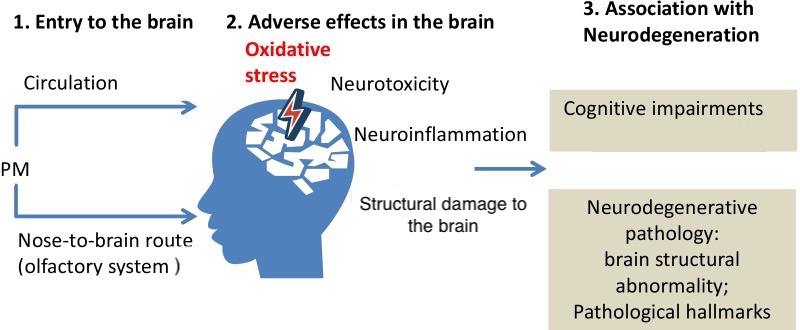
Microglia are the immune cells of the brain. When activated, they release reactive oxygen species to fight off invaders. However, too much of these reactive oxygen species can cause cellular stress and potentially cause neuronal death. It also disrupts the blood-brain barrier.
Dopaminergic neurons seem to be especially susceptible to the PM-induced stress: because regular dopamine metabolism already releases reactive oxygen species, dopaminergic neurons are more sensitive to changes in their homeostasis. This vulnerability could explain the link between PM exposure and neurodegenerative disease.
What these findings mean for public health
Although the study was conducted in Canada, its findings are relevant to other countries where average pollution levels remain above WHO guidelines. Recognizing the growing body of evidence pointing to the dangers of long-term exposure to PM2.5, the WHO lowered its guideline annual level from 10 μg/m3 to 5 μg/m3 in 2021. The UK, however, still relies on national regulations from 2010 to set exposure limits, which cite 20 μg/m3 as their cut off for annual average concentration of PM2.5.
While monitoring data suggest that average PM2.5 levels have been steadily declining across the UK since 2011, meeting the interim environmental target of sub-10 μg/m3 annual concentration of PM2.5 by 2040, the recorded numbers still exceed levels that scientists deem safe. For example, while participants in Dr. Azab’s study experienced an average PM2.5 exposure of 6.9μg/m3, UK monitoring sites recorded average concentrations of 8.00μg/m3 at urban background sites and 8.55 μg/m3 at roadside testing sites in 2025.
Although we do not yet know whether pollution-related cognitive changes are reversible, reducing both short- and long-term exposure is prudent. Checking the local air-quality index can help people limit outdoor activity during unusually polluted periods, but broader improvements will also require effective regulation, monitoring, and emissions reduction.
Additional References
Defra. WHO updates guideline levels for air pollutants. Gov.UK. 2021. https://deframedia.blog.gov.uk/2021/09/23/who-updates-guideline-levels-for-air-pollutants/
Gov.UK. Accredited official statistics: Particulate matter (PM10/PM2.5). Department for Environment, Food & Rural Affairs. Accessed on July 1, 2026 from https://www.gov.uk/government/statistics/air-quality-statistics/concentrations-of-particulate-matter-pm10-and-pm25
Levesque S, Taetzsch T, Lull ME, Johnson JA, McGraw C, Block ML. The role of MAC1 in diesel exhaust particle-induced microglial activation and loss of dopaminergic neuron function. J Neurochem. 2013 Jun;125(5):756-65. doi: 10.1111/jnc.12231. Epub 2013 Apr 2. PMID: 23470120; PMCID: PMC3660420.
WHO. Air quality, energy and health. Accessed on June 11, 2026 from https://www.who.int/teams/environment-climate-change-and-health/air-quality-and-health/health-impacts/types-of-pollutants
WHO. Ambient (outdoor) air pollution. 2024. Accessed on June 11, 2026 from https://www.who.int/news-room/fact-sheets/detail/ambient-(outdoor)-air-quality-and-health
You R, Ho YS, Chang RC. The pathogenic effects of particulate matter on neurodegeneration: a review. J Biomed Sci. 2022 Feb 22;29(1):15. doi: 10.1186/s12929-022-00799-x. PMID: 35189880; PMCID: PMC8862284.
Image Credits
Background photo: DragonDash. Factory, Smoke, Pollution. Pixabay. 2023. https://pixabay.com/photos/factory-smoke-pollution-8263188/
Foreground graphic: Canva

