
Reference: Arican, C., Bulk, J., Deisig, N., & Nawrot, M. P. (2020). Cockroaches show individuality in learning and memory during classical and operant conditioning. Frontiers in Physiology, 10, Article 1539.
I was at the dollar store yesterday because I wanted to buy cockroach spray, just in case my apartment ever gets an unwanted visitor. Like most people, I have often thought of cockroaches as unwelcome pests who create an unnecessary headache for humans, threatening to invade kitchens and contaminate food.
But, beneath their reputation as invaders lies something remarkable. Their brains are surprisingly complex and are capable of learning, remembering, and adapting. Scientists are discovering that cockroaches are not simply operating on instinct; they have the ability to associate smells with reward and avoid unpleasant experiences. Along with that, they also differ from one another in how quickly and consistently they learn. These differences in learning can be more effectively understood by examining the processes that shape how individuals acquire new behaviours, such as the principles of operant and classical conditioning.
What is Classical and Operant Conditioning?
Classical conditioning is a type of learning where an association is formed between two stimuli, i.e., two different events. A well-known example is Ivan Pavlov’s experiments with dogs, where he discovered that dogs could learn to associate the sound of a bell with food. Eventually, the dogs began salivating when they heard the bell, even before they saw the food. This was because the dogs had learned over time that one event predicts the other.

Image created using Google Gemini’s AI image generation tool by Shriya Biswas, 2026.
Operant conditioning is learning through consequences. In this type of learning, we can expect an animal to change or modify its behavior depending on a negative or positive outcome. For example, imagine driving your car without putting on your seatbelt, and the annoying seatbelt chime continues to ring until you put the belt on. This is an example of negative reinforcement: putting on the seatbelt removes the irritating sound.
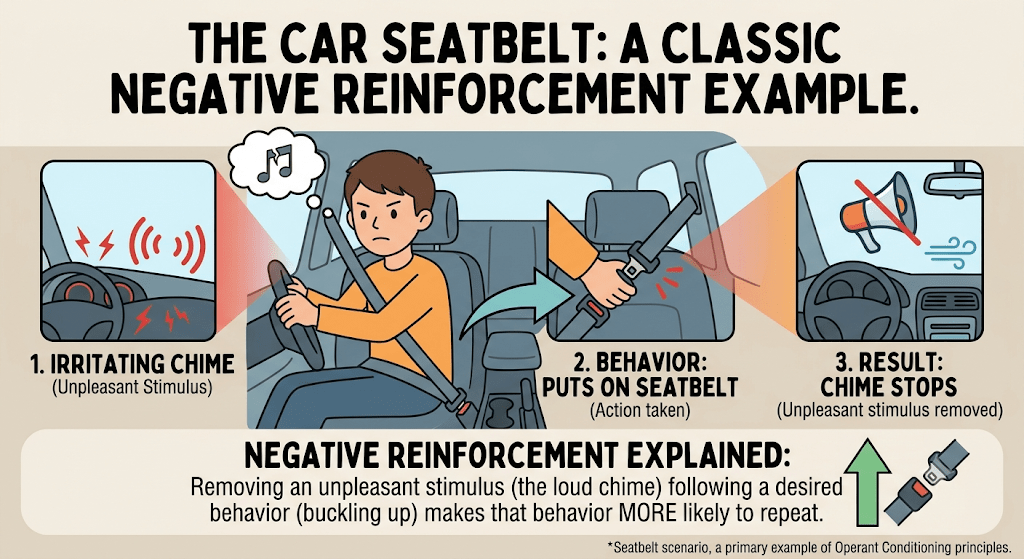
Image created using Google Gemini’s AI image generation tool by Shriya Biswas, 2026.
Classical Conditioning with Cockroaches: Learning That an Odor Predicts a Reward
A group of researchers used these learning paradigms to examine whether cockroaches (Periplaneta americana) showed individual differences in learning and memory. To test classical conditioning, odors were used, and a new method was developed.
The researchers measured a behaviour called “the maxilla-labia response (MLR)”, which is a movement of the cockroach’s mouthparts when it consumes food. As part of the experiment, one odor was paired with a sugar (sucrose) solution. The odor paired with the sugar solution was the positively reinforced conditioned stimulus (CS+). The sugar solution itself was the reward, or unconditioned stimulus. Along with this, another odor was paired with a salty solution, and this served as the unpleasant experience, thus becoming the conditioned stimulus negative (CS−), something the cockroach wanted to avoid.
After several repeated trials, the cockroaches learned these associations. They were more likely to show the MLR to the odor paired with sucrose and less likely to show it to the odor paired with saline. This showed that they could use their previous experiences to guide future behaviour.
To determine whether these learned associations were retained over time, the researchers conducted memory tests after different delays. In the classical conditioning experiments, cockroaches were tested 10 minutes, 1 hour, or 24 hours after training to see whether they still remembered the odor–reward association.
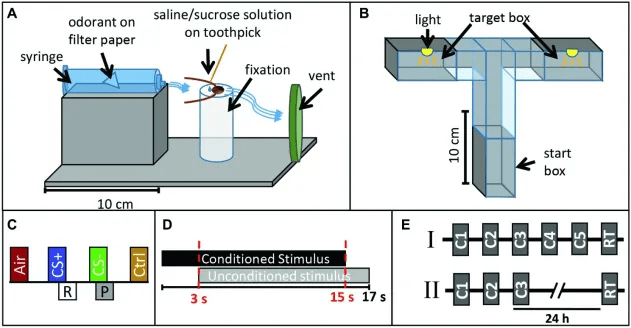
Image Credit: Figure 1 from Arican et al. (2020).
Cockroaches Have Individual Learning Abilities
As part of the experiment, along with looking at the average performance, the researchers also looked at the individual performances of the cockroaches. They discovered major differences among the insects.
Some of the cockroaches learned only after one or two training trials. The cockroaches who were “fast learners” continued to perform well during the experiment. Other cockroaches learned slowly, and others still showed little evidence of learning across the training trials..
This finding is interesting because insects are often viewed as animals that behave in predictable and automatic ways. But these results suggest otherwise: that cockroaches have their own learning abilities, which is similar to what scientists observe in humans.
Operant Conditioning in Cockroaches: Learning From Consequences
After the classical conditioning experiment, the researchers wanted to examine whether these differences were limited to classical conditioning or whether they appeared in operant conditioning as well.
Individual cockroaches were placed in a T-shaped maze and could choose between two paths: a path with a bright light and a path that did not have any light. Bright light served as an aversive consequence, because cockroaches generally prefer dark environments. Over time, many cockroaches avoided the arm in which they had previously experienced bright light.
What Do Cockroaches Teach Us About Learning?
Together, these experiments show that cockroaches differ in how quickly and consistently they learn from experience, and that these differences appear in both odor-based and spatial learning tasks.
The findings do not tell us that cockroaches are “intelligent” in exactly the same way humans are. But they do challenge the idea that insects are simply predictable, stimulus-response machines.
Intelligence is not simply about brain size. Studies like this remind us that sophisticated learning is not unique to mammals, or even vertebrates. A small nervous system can still support learning, memory, and meaningful differences between individuals.
So yes, I am still keeping the cockroach spray. But I may look at any future apartment intruder with a little more respect, especially if it disappears before I can reach it!


[…] is also a Cogbites contributor! You may have read her recent article, Not Just Pests: What Do Cockroaches Teach Us About Learning and Memory?, which explores how cockroaches learn through classical and operant conditioning—and why […]
LikeLike