
Welcome back to our Cogbites interview series, where we chat with cognitive scientists about what inspires their work—both in the lab and beyond.
As a reminder, you can learn more about our team of contributors by reading their bios on our author page (or at the bottom of each post). This series gives us the chance to spotlight early-career researchers and learn more about their paths into cognitive science. Last time, we featured Eloise Pedersen, whose research bridges comparative cognition and evolutionary biology.

This week’s interview is with Shriya Biswas, an incoming PhD student in the Human Development and Family Sciences program at the University of Delaware. Beginning in Fall 2026, Shriya will work with Dr. Heather Farmer, whose research examines biopsychosocial processes underlying health disparities among older adults. Shriya’s research interests include biopsychosocial aging, health equity, and health disparities.
Shriya is also a Cogbites contributor! You may have read her recent article, Not Just Pests: What Do Cockroaches Teach Us About Learning and Memory?, which explores how cockroaches learn through classical and operant conditioning—and why individual cockroaches differ in their learning abilities. Through humor, everyday examples, and a personal story, Shriya makes some surprisingly complex research on insect learning approachable for a broad audience.
Without further ado, here’s our interview with Shriya:
Why did you decide to pursue cognitive science?
My interest in cognitive science grew from my background in neuroscience and my curiosity about how biological processes translate into the way we think, behave, and interact with the world around us. During my undergraduate studies, I became especially interested in cognition across the lifespan and how factors beyond the brain itself—including social experiences, health, and the environment—can shape cognitive outcomes. This ultimately led me toward an interdisciplinary approach to studying the mind and behavior, and I’m now pursuing a PhD in Human Development and Family Sciences at the University of Delaware!
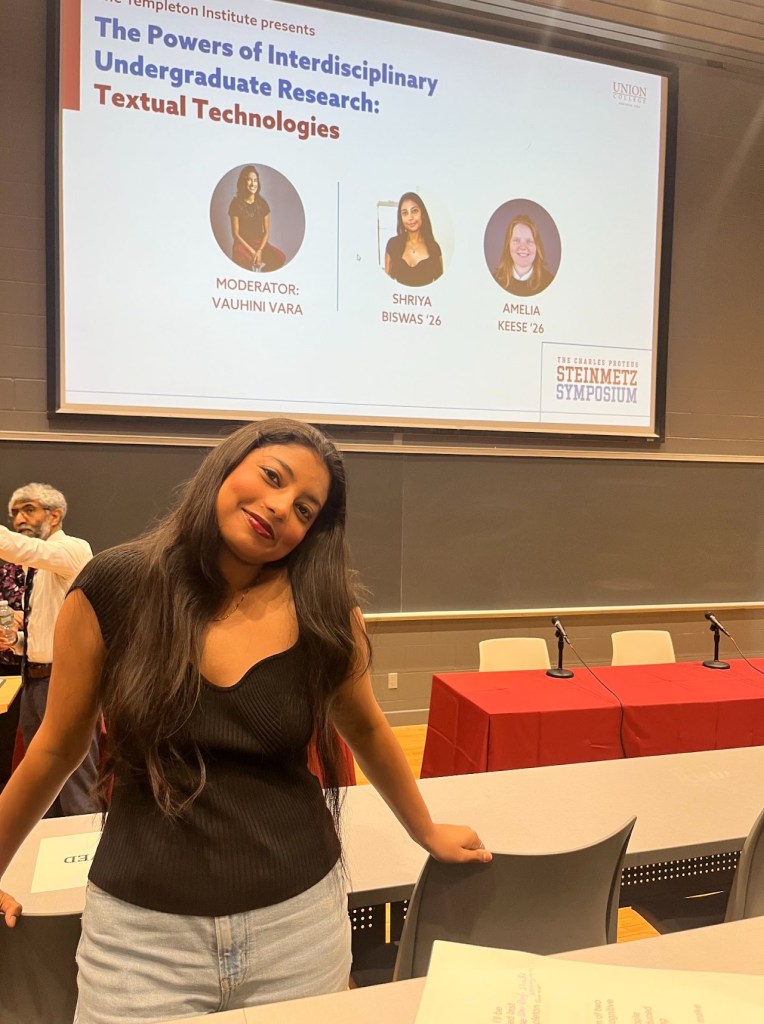
What are you currently working on?
As I begin my PhD, I’ll be pursuing research focused on aging and health disparities. I’m especially interested in taking an interdisciplinary approach to understanding how social, psychological, and biological factors work together to shape health across the life course.
What’s the most exciting concept in cognitive science?
One of the most exciting ideas to me is that cognition is not isolated within the brain! Our cognitive abilities are shaped by interactions among biological processes, psychological experiences, and our social and physical environments.
I find this especially fascinating when thinking about aging. Cognitive change is often discussed as though it is simply a consequence of what happens inside the brain, but factors such as stress, social relationships, health, and socioeconomic conditions can also influence cognitive outcomes. Understanding how these factors interact can help us develop a much more complete picture of how cognition changes across the lifespan—something I hope to explore throughout my PhD journey!
What sparked your interest in science communication?
To me, science communication is an opportunity to make research more accessible while also helping people understand why scientific discoveries matter in their everyday lives. I became interested in science communication because I’ve seen how difficult it can be to translate complex research into information that is accessible and meaningful to people outside of academia. I enjoy finding ways to bridge that gap and make science engaging for a broader audience.

Is there anything else you want us to know about you?
Outside of research, I love writing, listening to music, going to the gym, and, especially, traveling! I love exploring all kinds of places, whether it’s a major city or a small town I’ve never heard of before. Since pursuing a career in science can be demanding, I often only have a few days to explore a new place, so I’ve learned to make the most of every trip!


[…] researchers and learn more about their paths into cognitive science. Last time, we featured Shriya Biswas, whose research interests include biopsychosocial aging, health equity, and health […]
LikeLike