
Reference: Del Maschio, N., Sulpizio, S., Gallo, F., Fedeli, D., Weekes, B. S., & Abutalebi, J. (2018). Neuroplasticity across the lifespan and aging effects in bilinguals and monolinguals. Brain and Cognition, 125, 118–126.
What if your brain could age without your mind slowing down?
Brain changes are inevitable as we get older. One common change is the gradual loss of grey matter—the brain tissue involved in everything from processing information to controlling attention. However, these structural changes do not necessarily mean that we will experience comparable declines in our cognitive abilities.
So what helps some brains keep up? One possibility is something that approximately half of the global population does: speak more than one language.
Del Maschio and colleagues investigated whether speaking two languages might protect the aging brain against cognitive decline. The researchers were particularly interested in two ideas: neural reserve and cognitive reserve.
Neural reserve refers to the brain’s structural resources—think of it as a biological buffer. Cognitive reserve refers to the brain’s ability to maintain performance despite age-related structural changes.
The researchers wanted to investigate both of these, and to do that, they compared four groups. They included 22 young bilingual adults, 22 young monolingual adults, 22 older bilingual adults, and 22 older monolingual adults. This design allowed the researchers to compare older and younger adults, as well as bilingual and monolingual participants.
Participants completed an MRI scan so the researchers could measure grey matter volume. . Participants also completed a task measuring executive control, which is the ability to focus, ignore distractions, and manage competing information.
This task was an arrow game. But not an ordinary one.
When arrows try to trick your brain
The participants in the study saw arrows on a computer screen and had to respond based on the direction of the arrow in the middle.
For example, sometimes the arrows pointed in the same direction, as shown below.
→ → → → →
Easy enough? Well, wait for it!
Because at times they were like this: ← ← → ← ←
That is where the trick comes in. The surrounding arrows are telling the brain one thing while the middle arrow is telling it another. This puts the brain in a dilemma. To get the correct answer, the participants had to ignore the distracting arrows and focus only on the target.
This task allowed the researchers to measure how effectively participants could focus on relevant information while ignoring conflicting information.
The results showed that older adults had less grey matter than the younger adults across the brain regions involved in executive control. However, an interesting observation was made across the language groups.
Two languages, more brain reserve?
Across both younger and older adults, researchers noticed that bilingual participants had greater grey matter volume than their monolingual participants. This pattern was noted throughout regions of the executive-control network, including areas of the prefrontal cortex, anterior cingulate cortex, and inferior parietal lobes.
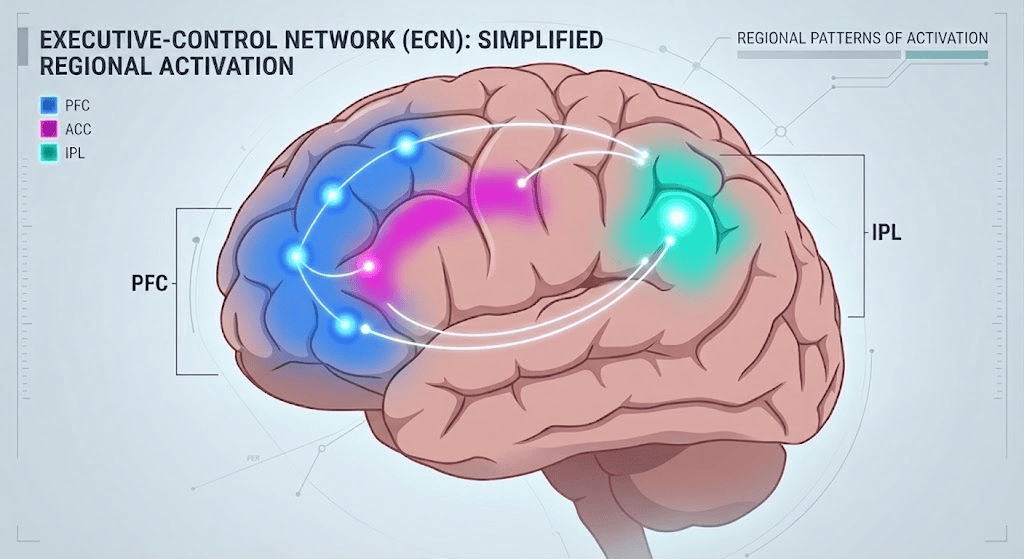
Image created using Google Gemini’s AI image generation tool by Shriya Biswas, 2026.
In other words, bilingualism was associated with greater grey matter volume in regions involved in controlling attention and responses. Notably, this difference was already evident among younger adults. The younger bilingual participants showed greater grey matter volume than the younger monolingual participants.
However, having more grey matter did not automatically mean being better at the arrow task. Researchers found that young bilinguals did not show a clear performance advantage over their monolingual peers. The real difference occurred later in life.
The older the brain, the bigger the difference
Older bilingual adults responded faster on the Flanker task than older monolingual adults. . However, the fact that bilingual seniors were faster was not the most interesting finding. It was what their performance looked like alongside their brain changes. Both groups of older adults had less grey matter than the corresponding groups of younger adults. Yet, their cognitive performance did not respond to that loss in the same way.
In older monolinguals, less grey matter was associated with slower performance. As their available neural tissue decreased, their ability to handle conflicting arrows became more vulnerable. But in the older bilinguals, this relationship largely disappeared. Among older bilingual adults, however, grey matter volume was not clearly related to response speed; their performance remained relatively consistent across different levels of grey matter volume
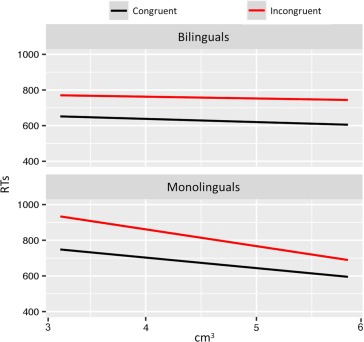
Image Credit: Figure 2 from Del Maschio et al 2018.
It was almost like their brains had some other way of getting the job done. This is where the distinction between neural and cognitive reserve becomes especially important.
Bilingualism appears to be related to greater neural reserve, which means that bilingual individuals have greater grey matter volume in important executive control areas. Along with this, older bilinguals also appear to have cognitive reserve, which is the ability to maintain performance even when some neural reserve is lost.
These results suggest that having more grey matter may only be a part of the story. As we age, how effectively the brain uses its remaining resources may matter as much as the amount of brain tissue retained.
Why might speaking two languages help?
Managing two languages does not simply mean knowing twice as many words. Anytime a bilingual speaker communicates, their brain has to choose which language to use and actively block the other from interfering. Depending on the situation, bilingual speakers might have to switch between two languages, monitor what they hear and say, and suppress competing responses.
This constant juggling on an everyday basis may exercise the same control systems involved in a Flanker task. Over many years, this repeated practice could contribute to differences in the brain structure and cognitive strategies used to manage competing information.
However, there is an important catch…
The results do not mean bilingualism stops brain aging. The study found that older bilinguals still lose grey matter volume like monolingual seniors. What differed was how closely that decline was linked to cognitive performance.
Because this was a cross-sectional study, the researchers could not determine whether bilingualism caused these differences or whether the groups differed in other relevant ways. Moreover, the bilingual participants were recruited in Hong Kong, whereas the monolingual participants were recruited in Milan. Cultural, educational, socioeconomic, lifestyle, or other differences between the samples may therefore have contributed to the findings.
However, this research still provides an intriguing perspective on the aging brain. Cognitive aging may depend not only on how much brain tissue we lose, but also on how effectively our brains adapt to those changes.
So, whether you already speak multiple languages or are beginning to learn another, keep practicing. Saying hola, こんにちは, or नमस्ते may not stop the brain from aging—but regularly navigating more than one language could help keep it flexible.

